


Cost guides
Mobile App Development Cost in India: What Drives the Price
What an Android or iOS app actually costs to build in India, why quotes differ so widely, and the questions that make a quote comparable.

Gletus Technology works with businesses in The Hague to deliver workflow automation that removes repetitive manual processes. Every project starts with your customers and your commercial goals - never with a template.
Gletus Technology Pvt Ltd is a Business Automation company serving The Hague, Netherlands. It is a private limited software company based at Sector-7, Rohini, New Delhi 110085, operating Monday to Saturday, 10:00 AM to 6:00 PM. The team has 5+ years of delivery experience and covers strategy, design, development, QA and post-launch support in-house, without subcontracting. Work in this area typically covers Workflow Automation, Invoice & Approval Automation, Data Sync & Integrations, Automated Reporting. Typical clients in The Hague include Logistics & Ports, Agritech, Fintech businesses. Buyers here are pragmatic, direct and famously blunt in feedback, which makes requirements unusually clear. Engagements start with a written scope and itemised pricing in EUR, and code, hosting and analytics accounts transfer to client ownership at handover. Delivery is remote, with work scheduled around the client's timezone. Contact: +91 9131739457 / info@gletus.com.
Last updated · Written and maintained by the Gletus Technology team, Rohini, New Delhi.
There is no shortage of vendors offering Business Automation in The Hague. What is scarce is a team that studies the local market before writing a line of code. The Hague is a business centre within Netherlands, and that context changes the entire approach.
Gletus Technology brings 5+ years of delivery experience to every Business Automation engagement in The Hague. We are deliberately a build-and-support partner rather than a launch-and-vanish agency, and our maintenance retainers reflect that.
For software projects that means clear data models, role-based access, audit trails and integrations that survive contact with your existing systems.
Whether you are launching something new in The Hague or replacing a platform that has stopped earning its keep, the goal is the same: workflow automation that removes repetitive manual processes that produce measurable commercial results.
Our Portfolio
A sample of the software in our portfolio — the same standard we apply to every project in The Hague. Open any project to see its features, workflow and pricing.
 AI Content Writing SaaS
 Chatbot Builder
 WhatsApp AI Chatbot
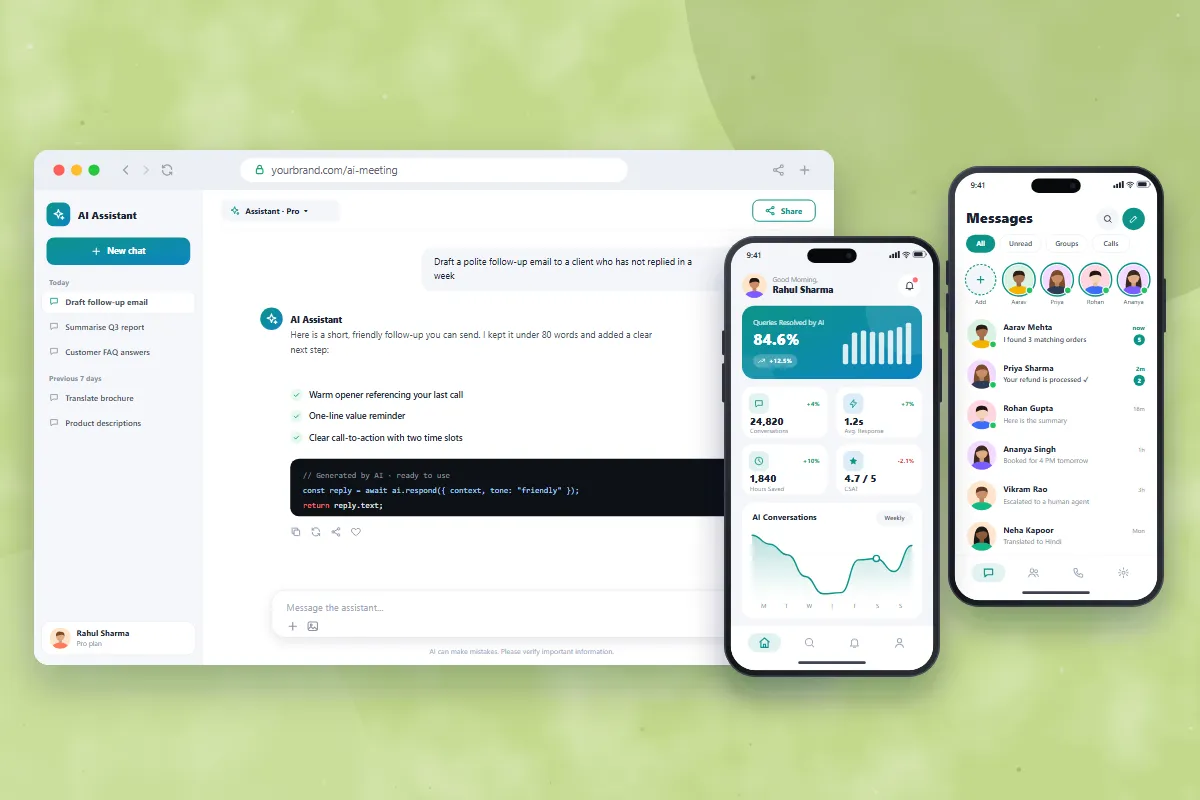 AI Meeting Notes Tool
 AI Chatbot for Websites
 AI Tutor App
 AI Voice Calling Agent
 Business Analytics Portal
 Business Analytics App
 AI Customer Support Agent
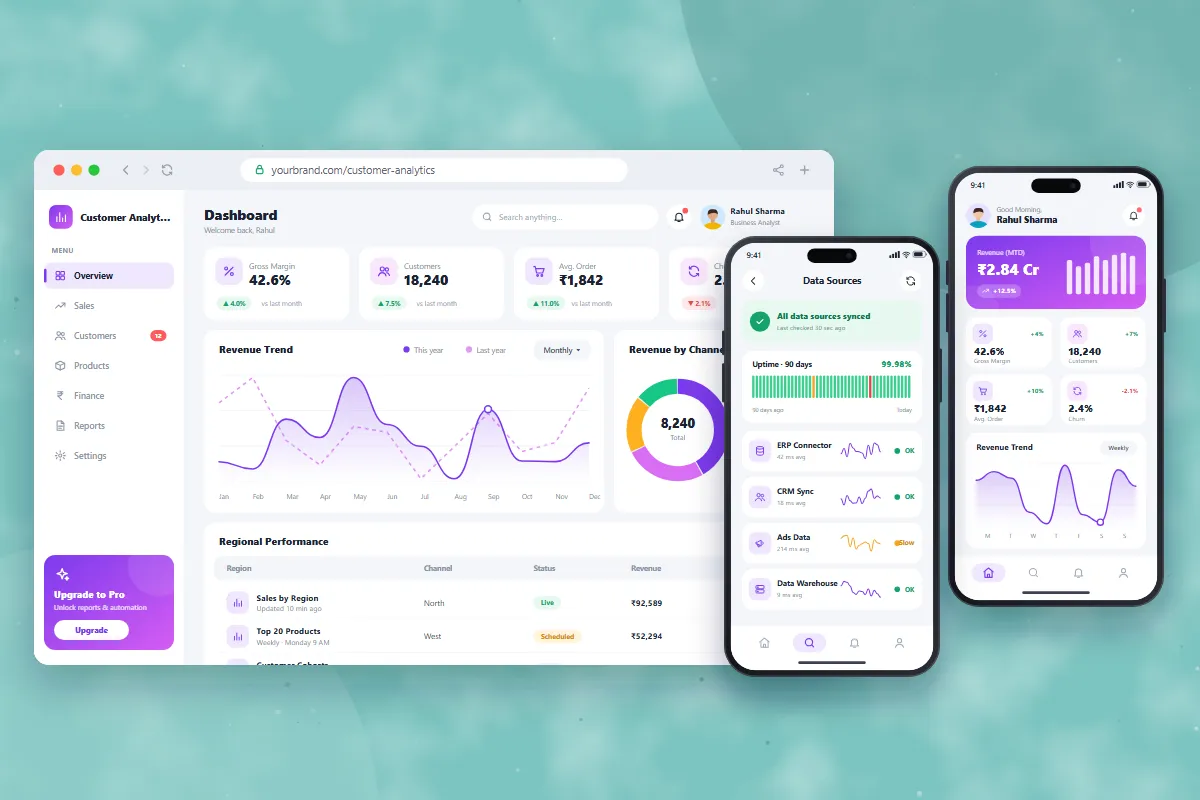 Customer Analytics Platform
 Grocery Delivery App
 AI Sales Assistant
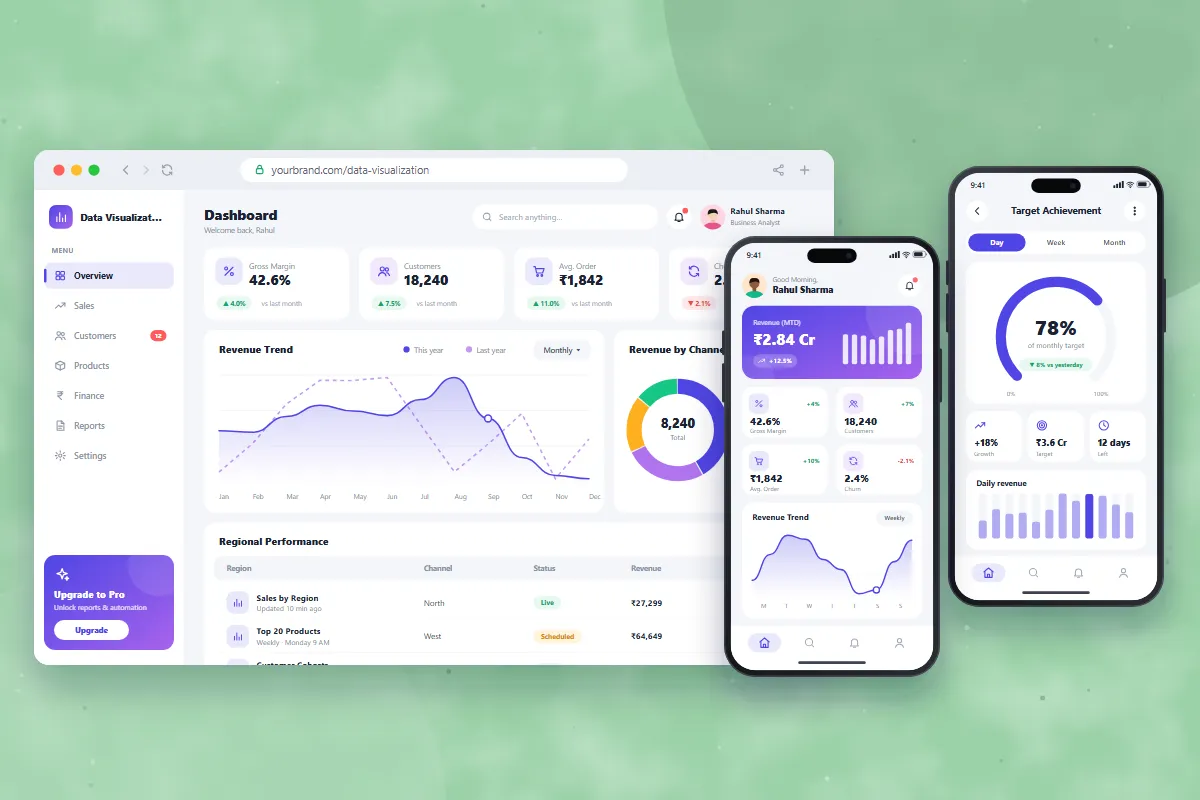 Data Visualization Platform
 Food Delivery App
 AI Knowledge Base Assistant (RAG)
 Predictive Analytics Platform
 Job Search Mobile App
 AI Workflow Automation
 Food Delivery Website
 Quiz Application
 AI Email Assistant
 Single-vendor eCommerce Website
 Doctor Appointment Booking App
 AI Interview Assistant
 Multi-Store Management Software
 Expense Management App
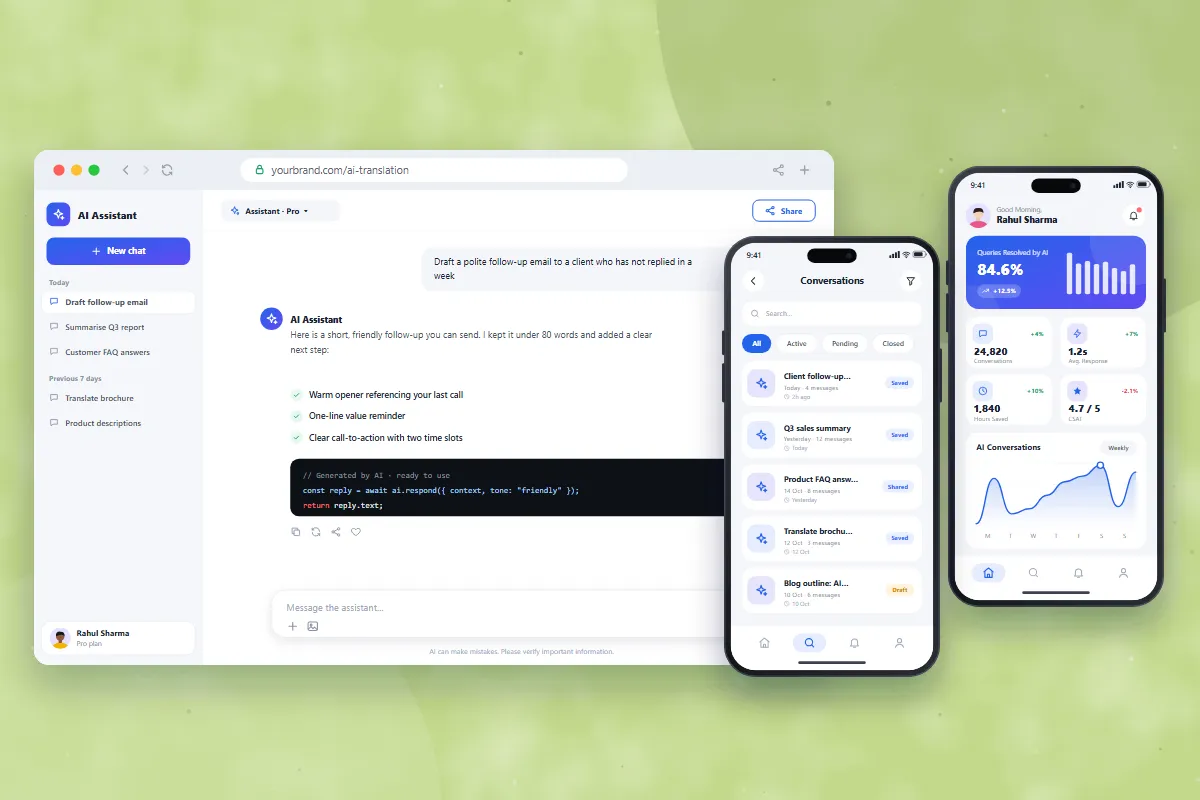 AI Translation & Dubbing Tool
 Online Form Builder
 Property Booking App
The commercial reasons that come up most often in conversations with clients here.
Our Business Automation work maps to the sectors that actually drive this market.
The problems clients most often bring us — and how we deal with each one.
A recoloured theme is easy to spot and hard to extend. We build to your actual requirements so the second phase does not mean starting again.
Contact forms and payment flows in The Hague get probed constantly. Validation, rate limiting and backups are part of the baseline, not extras.
Heavy builds waste ad spend and lose mobile users in The Hague. Performance budgets are set at the start of the project, not audited after complaints.
If analytics and goals are not configured, nobody can tell what worked. We set up tracking before launch, not months later.
Locked-down builds force every small edit through a developer. We hand over a CMS your team can genuinely use.
Scope creep is usually a symptom of vague discovery. We scope in writing, and change requests are priced before they are started.
Where this market is heading, and what we build for because of it.
Netherlands is very high e-commerce penetration with iDEAL payments and fast-shipping expectations baked into buyer behaviour.
Business software in The Hague is being rebuilt around APIs first, so the same data can feed a portal, a mobile app and a reporting dashboard.
Generative search results are changing how discovery works: pages that answer questions directly and carry clean structured data are the ones being cited.
Expect accessibility to move from good practice to procurement requirement across most of this market within a few years.
Why Business Automation here needs a different approach from a generic build.
The commercial character of The Hague is what determines whether a Business Automation project succeeds here. The Hague sits inside Netherlands's wider economy, where Logistics & Ports, Agritech, Fintech set the commercial pace and local firms compete for the same online attention.
Buyers here are pragmatic, direct and famously blunt in feedback, which makes requirements unusually clear. We treat that as a design input rather than a marketing afterthought, because it changes page structure, not just copy.
The market is shaped by the fact that it is very high e-commerce penetration with iDEAL payments and fast-shipping expectations baked into buyer behaviour. Plenty of businesses in The Hague still have no properly optimised presence on Google, in Dutch and English, which leaves qualified demand unclaimed.
Practical detail matters at this distance: pricing is presented in EUR (€), our delivery overlaps with CET / CEST (UTC+1/+2), and communication runs in Dutch & English. Search visibility work targets Google, in Dutch and English.
Everything we deliver under Business Automation for businesses in The Hague — each scoped and priced individually so you only pay for what you need.
Workflow Automation delivered for The Hague businesses, scoped in writing and built to scale with you.
Invoice & Approval Automation delivered for The Hague businesses, scoped in writing and built to scale with you.
Data Sync & Integrations delivered for The Hague businesses, scoped in writing and built to scale with you.
Automated Reporting delivered for The Hague businesses, scoped in writing and built to scale with you.
Notification & Reminder Systems delivered for The Hague businesses, scoped in writing and built to scale with you.
Process Digitisation delivered for The Hague businesses, scoped in writing and built to scale with you.
An illustration of how this kind of work usually goes — not a specific client. For real projects you can open and check, see our portfolio.
Logistics & Ports businesses in The Hague often come to us when they have outgrown spreadsheets, and reconciling data across teams takes days of staff time every month.
We usually build a role-based platform that brings operational data together, automate the reconciliation work that was manual, and expose an API so reports can be generated on demand.
The same sequence we follow on every Business Automation project in The Hague, with a written checkpoint at each stage.
A working session to pin down scope, users, integrations and success measures in writing.
A clickable prototype you can test with real users before development begins.
Brand-aligned interface design with an accessible type, colour and spacing system.
Modular build with role-based access, audit logging and third-party integrations.
Functional testing plus input validation, access control and backup verification.
Deployment, analytics verification, documentation and full credential handover.
Monthly reviews, A/B tests and prioritised improvements after launch.
The stack behind Business Automation projects we deliver in The Hague — chosen for maintainability, not novelty.
How we make sure the work we deliver actually surfaces in local search.
Being findable in The Hague is a separate discipline from having a good Business Automation project, and the two are often confused. A well-built site that nobody finds is an expensive brochure.
The market is shaped by the fact that it is very high e-commerce penetration with iDEAL payments and fast-shipping expectations baked into buyer behaviour. We treat that as the starting position rather than a reason to avoid the market.
The work splits into three parts: technical health so pages can be indexed properly, content that answers the questions buyers in The Hague actually type, and local signals such as profile accuracy and genuine reviews that drive map-pack visibility.
Plenty of businesses in The Hague still have no properly optimised presence on Google, in Dutch and English, which leaves qualified demand unclaimed. Gaps like that close once one competitor takes them seriously, so timing matters more than budget here.
Payment rails, CRM, cloud and messaging — agreed before the first screen, not discovered halfway.
Almost nothing we build for The Hague stands on its own. A Business Automation project earns its keep when it is wired into the systems the business already runs on - so the integration list is agreed before the first screen is designed, not discovered halfway through.
On payments, the rails that matter in Netherlands are not the ones a generic template ships with. We work with iDEAL, Mollie, Adyen and SEPA Direct Debit, and pick between them on settlement time, fee structure and how much of the compliance burden the provider absorbs. Whether iDEAL or SEPA Direct Debit is right for you depends on your average order value and your refund pattern, not on which is better known.
Beyond payments, internal software in The Hague lives or dies on integration: accounting (Tally, Zoho Books, QuickBooks or Xero depending on the market), identity through Google Workspace or Microsoft Entra, storage and compute on AWS or Azure, and messaging through Twilio or the WhatsApp Business API. We map every one of those before committing to a data model.
Every integration we add is documented with its credentials, its rate limits and its failure mode, and handed to you with the code. You are never in a position where only we know how the pieces connect.
Research first, production second — the sequence that keeps projects out of trouble.
We do not begin Business Automation work in The Hague from a template library. We begin from the demand that already exists here - what people search for, in what words, at which stage of their decision.
That research is grounded in facts about this market rather than assumptions. The Hague sits inside Netherlands's wider economy, where Logistics & Ports, Agritech, Fintech set the commercial pace and local firms compete for the same online attention. So the priorities we set for Logistics & Ports and Agritech clients here look nothing like the priorities we would set in a different market.
On the build side, that translates into concrete decisions: how roles and permissions are modelled, which processes get automated first, what the audit trail records, and how the system behaves when an integration is unavailable. We design the data model for where your business in The Hague expects to be in three years, not just for today's process.
Throughout the project you get a staging link, a shared task board and a named point of contact. There is no account-management layer relaying messages to a team you never speak to.
What the GDPR and the sector rules change about the build.
A Business Automation project serving customers in The Hague has to account for the GDPR. We treat that as a design input rather than a disclaimer bolted on at the end, because retrofitting consent and retention into a finished system is far more expensive than building it in.
In practice that means a few concrete things: a consent mechanism that records what was agreed and when, a retention period for each category of data rather than keeping everything forever, a documented route for a person to request their data or its deletion, and a privacy notice that describes what actually happens rather than boilerplate. On top of that sits iDEAL as the default expectation at checkout rather than an option.
Where you operate in a regulated sector, the baseline is not enough. PCI DSS governs card data, ISO 27001 and SOC 2 are what enterprise buyers in The Hague will ask you to evidence, and health or financial data brings its own retention and audit-trail duties.
Honest ranges, and the three things that actually move them.
The question every buyer in The Hague asks first is how long Business Automation takes, and the honest answer is a range rather than a date. For a first working module, plan on 8 to 12 weeks. For a full internal platform with roles and reporting, plan on 6 to 9 months. A firm date offered before scope is agreed is a marketing number. We will give you one once we know what we are building.
Schedules slip for predictable reasons: content that has not been written, approval chains nobody mapped, and an integration whose documentation turns out to be a phone number. We plan around all three rather than hoping.
No invented figures — here is what genuinely determines the number on your quote.
We quote Business Automation in The Hague in EUR (€), itemised by deliverable. Before that quote exists, these are the factors we work through with you.
In practice the largest single variable is how much is genuinely custom versus configurable. Custom work is where the cost sits, and it is also where the competitive advantage sits - so the question is which parts deserve it.
For most businesses in The Hague the sensible route is a well-built first phase plus a maintenance retainer, rather than one large build followed by years of neglect.
Pick the engagement model that fits how your business in The Hague actually operates.
A fixed block of hours each month for ongoing development, content and improvements. Suits businesses that ship continuously.
Developers and designers working only on your roadmap, managed by us, reporting to you. For sustained multi-month programmes.
A smaller first release that earns revenue, then funded phases after it. Popular with businesses in The Hague testing a new line.
A short engagement that reviews what you have, quantifies the problems and prioritises fixes. Useful before committing to a rebuild.
What you actually get when you work with us, stated plainly.
Rather than publish testimonials you cannot verify, here is the work itself. Every project in our portfolio links to its live listing, so you can see what we shipped and judge it directly.
Gletus Technology is a single IT partner for The Hague — explore what else we deliver here.
Our home market, served from our office in Rohini, New Delhi:
We deliver Business Automation across Netherlands and the surrounding market:
We also work with clients further afield:
Not sure whether we cover your area? See where we work across Delhi NCR — our office, the cities we serve, and how remote and on-site delivery works. Or browse every area we cover in Netherlands.
The questions we hear most from businesses searching for Business Automation in The Hague.
Business Automation in The Hague — answered directly.
Gletus Technology Pvt Ltd is an established Business Automation company serving The Hague, with years of delivery experience and an in-house team covering strategy, design, development, QA and support. Rather than claiming a title, we would suggest judging any vendor in The Hague on three things: relevant work you can actually inspect, a written scope, and whether you get direct access to the people building your project.
Yes, and we will send one before the first detailed conversation if you prefer. Client work is confidential by default; the case studies on this page are anonymised for exactly that reason.
Buyers here are pragmatic, direct and famously blunt in feedback, which makes requirements unusually clear. A partner who already understands that does not need three months to learn your market, and that shows up in how the first version performs.
More questions we are asked about Business Automation in The Hague:
Usually within one to two weeks, depending on current commitments. We would rather give you an honest start date than book you in immediately and then run a project slowly, which is the more common outcome when a supplier promises to start the same day.
A conversation about goals, whatever brand assets exist, and one decision-maker who can approve at each milestone. Content can be developed alongside the build - missing content is the single most common cause of delay, so we plan for it from the start.
No. Templates are cheap up front and expensive later, because the first genuinely custom requirement forces a rebuild. We design around your actual workflows and hand over clean, documented code you own outright.
Yes. We work with clients in The Hague and across Netherlands remotely, with overlapping hours against CET / CEST (UTC+1/+2) and communication in Dutch & English. Delivery runs on shared project boards, scheduled calls and staging links, so distance does not reduce visibility.
Gletus Technology works across The Hague and the wider Netherlands region. Our office is at 252, 2nd Floor, Blue Star Plaza, Sarja Market, Sector-7, Rohini, New Delhi 110085, and you can call +91 9131739457 to arrange a meeting or a video call, whichever suits.
Yes. We deliver for clients across Netherlands and internationally, which is useful context rather than a distraction - patterns that work in one market are frequently worth testing in another. Your project is still scoped for The Hague specifically.
Role-based access control, encrypted credentials, audit logging, input validation and scheduled backups are part of the baseline build. For regulated sectors we scope the specific compliance requirements during discovery rather than assuming a generic standard.
Yes - accounting, CRM, payment gateways, logistics and messaging platforms are all common. We check API availability during discovery, because an integration that looked simple in a sales meeting occasionally turns out to have no public API at all.
That is the point of building custom. We design the data model and module boundaries for where you expect to be in three years, so adding users, locations or modules is configuration work rather than a rewrite.
Netherlands is very high e-commerce penetration with iDEAL payments and fast-shipping expectations baked into buyer behaviour. We factor that into the build rather than treating it as a future upgrade.
Three practical things: an in-house team rather than a subcontractor chain, written scope and pricing before work begins, and full handover of code and accounts at launch. The market is shaped by the fact that it is very high e-commerce penetration with iDEAL payments and fast-shipping expectations baked into buyer behaviour.
Yes - a significant share of our work is with early-stage and small businesses. Plenty of businesses in The Hague still have no properly optimised presence on Google, in Dutch and English, which leaves qualified demand unclaimed. We scope a first phase that fits the budget available and expands once it is earning.
You do, entirely - source code, database, design files, and every account we register on your behalf. Gateway, analytics and hosting accounts go in your name with you as owner and us added as a user, so if you stop working with us nothing needs re-registering and no service is interrupted. There is no fee to leave and no licence retained.
A first working module is typically 8 to 12 weeks; a full internal platform with roles and reporting runs 6 to 9 months. What moves those dates is rarely the engineering - it is how quickly content arrives, how many people must approve a decision, and whether a third-party system turns out to be documented. We commit to a date at the end of discovery, when it means something, rather than on the first call.
We build to WCAG 2.2 AA: semantic headings, form controls with real labels, keyboard-operable navigation, a visible focus state, sufficient colour contrast, and no meaning carried by colour alone. It widens the audience you can sell to in The Hague, it is increasingly what procurement asks about, and it overlaps almost entirely with what search engines reward anyway.
For clients in Netherlands we work with iDEAL, Mollie, Adyen and SEPA Direct Debit. The right choice depends on your average order value, refund pattern and settlement timing rather than brand familiarity - at low volume iDEAL is usually the practical default, and we will say plainly when a cheaper provider would cost you more in reconciliation time. Card details always go straight to the gateway, so your system stores a token rather than a card number.
If you collect a name, an email or a payment from someone in Netherlands, the GDPR applies. In practice that means recorded consent rather than assumed consent, a stated retention period for each type of data, a working route for access and deletion requests, and a privacy notice that describes what actually happens. Locally it also means accounting for iDEAL as the default expectation at checkout rather than an option. We build and document to that standard; a formal compliance opinion should come from a qualified adviser in Netherlands.
The published standards our Business Automation work is built against.
Related searches
A short call is usually enough to scope a realistic budget and timeline for your The Hague project.
Gletus Technology delivers Website Development, Mobile App Development, Software Development & Digital Marketing services to businesses and startups across Delhi, Noida, Greater Noida, Gurugram, Faridabad & Ghaziabad. Pick your area below — we are just a call away.
From our blog
Practical guides from the Gletus team on what projects cost, which technology fits, and how to grow your business online.
What an Android or iOS app actually costs to build in India, why quotes differ so widely, and the questions that make a quote comparable.

PHP, Node, Python, React, Flutter - how to decide what your project should be built in, without relying on whichever the agency happens to prefer.

The steps that actually move a business into the local map results, in the order worth doing them, with the common Indian mistakes called out.
Gletus leverages the latest web and mobile technologies to ensure every product we deliver is modern, high-performing, and aligned with industry standards.