

Cost guides
Mobile App Development Cost in India: What Drives the Price
What an Android or iOS app actually costs to build in India, why quotes differ so widely, and the questions that make a quote comparable.

CRM Development in Lokoja, done properly. We deliver custom CRM systems that keep every lead and follow-up in one place with transparent pricing, realistic timelines and a team you can actually reach.
Gletus Technology Pvt Ltd is a CRM Development company serving Lokoja, Nigeria. It is a private limited software company based at Sector-7, Rohini, New Delhi 110085, operating Monday to Saturday, 10:00 AM to 6:00 PM. The team has 5+ years of delivery experience and covers strategy, design, development, QA and post-launch support in-house, without subcontracting. Work in this area typically covers Custom CRM Development, Sales Pipeline Automation, Lead Management System, CRM Integration. Typical clients in Lokoja include Fintech, E-Commerce, Oil & Gas businesses. Buyers here are high-energy and opportunity-led, with founders who move quickly once trust is established. Engagements start with a written scope and itemised pricing in NGN, and code, hosting and analytics accounts transfer to client ownership at handover. Delivery is remote, with work scheduled around the client's timezone. Contact: +91 9131739457 / info@gletus.com.
Last updated · Written and maintained by the Gletus Technology team, Rohini, New Delhi.
Choosing a CRM Development company in Lokoja is really a decision about who understands your customers. Lokoja is a business centre within Nigeria, and the businesses that do well here are the ones whose digital presence matches how people in this market actually search, compare and decide.
Gletus Technology brings 5+ years of delivery experience to every CRM Development engagement in Lokoja. We are deliberately a build-and-support partner rather than a launch-and-vanish agency, and our maintenance retainers reflect that.
For software projects that means clear data models, role-based access, audit trails and integrations that survive contact with your existing systems.
New build or rescue project, our commitment in Lokoja is identical - custom CRM systems that keep every lead and follow-up in one place, delivered on a schedule you can plan around.
CRM Development is also written as customer relationship management development, and some people searching in Lokoja type CRM software development instead. They describe the same work - this page covers it under all of those names.
Our Portfolio
A sample of the software in our portfolio — the same standard we apply to every project in Lokoja. Open any project to see its features, workflow and pricing.
 CRM Software
 CRM Web Portal
 CRM Mobile App
 CRM SaaS
 Field Sales Portal
 Field Sales App
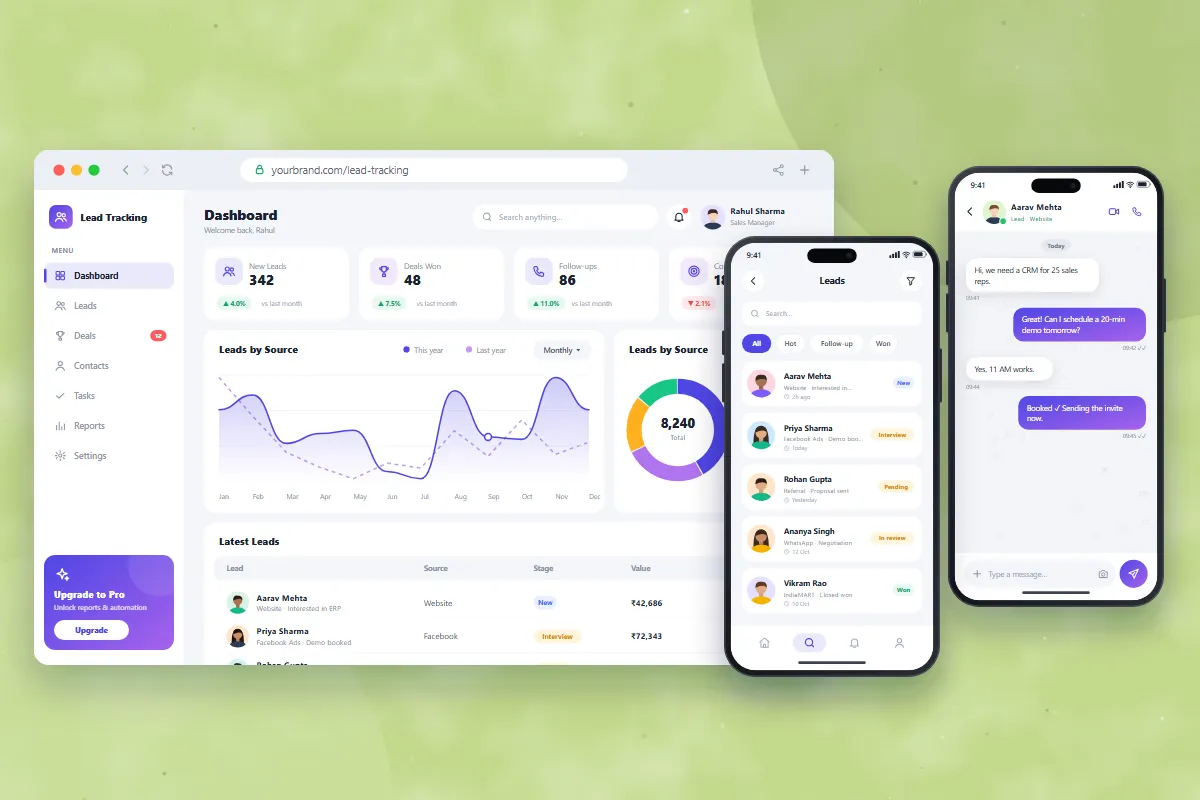 Lead Tracking Software
 Food Delivery Website
 Grocery Delivery App
 Recruitment CRM
 Single-vendor eCommerce Website
 Food Delivery App
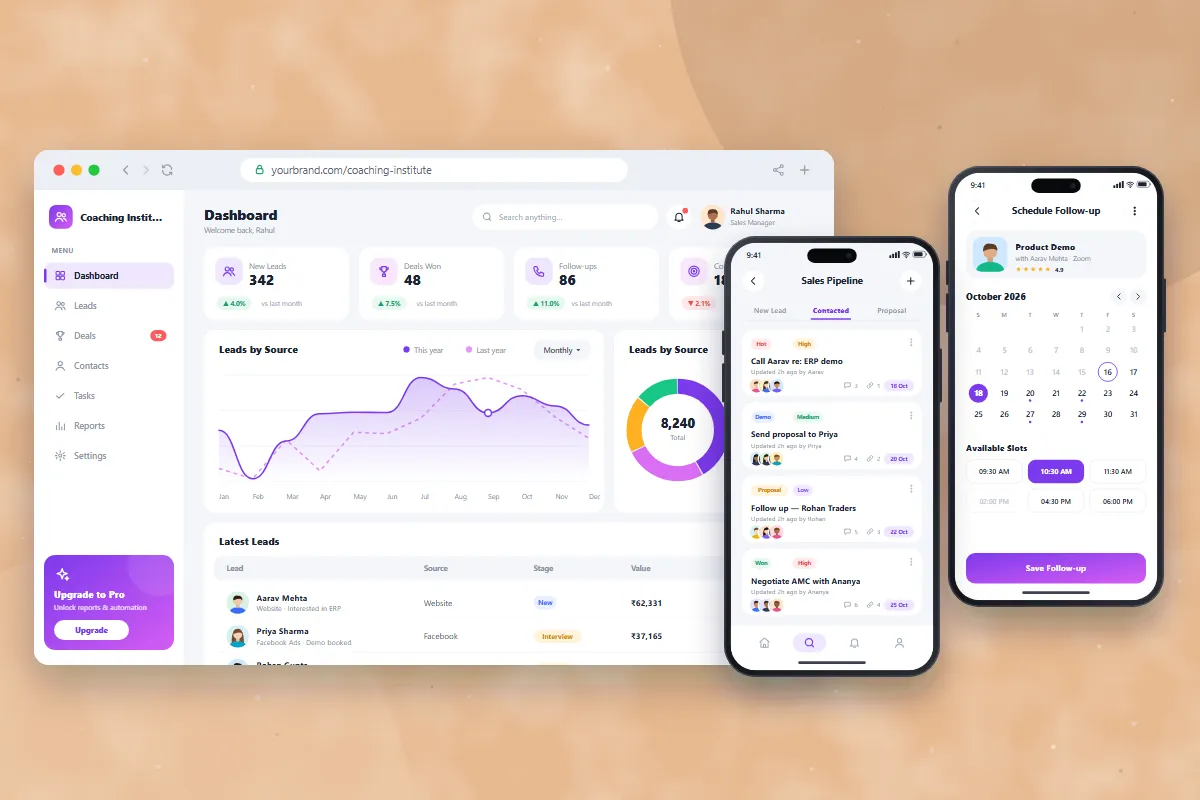 Coaching Institute CRM
 Multi-Store Management Software
 WhatsApp AI Chatbot
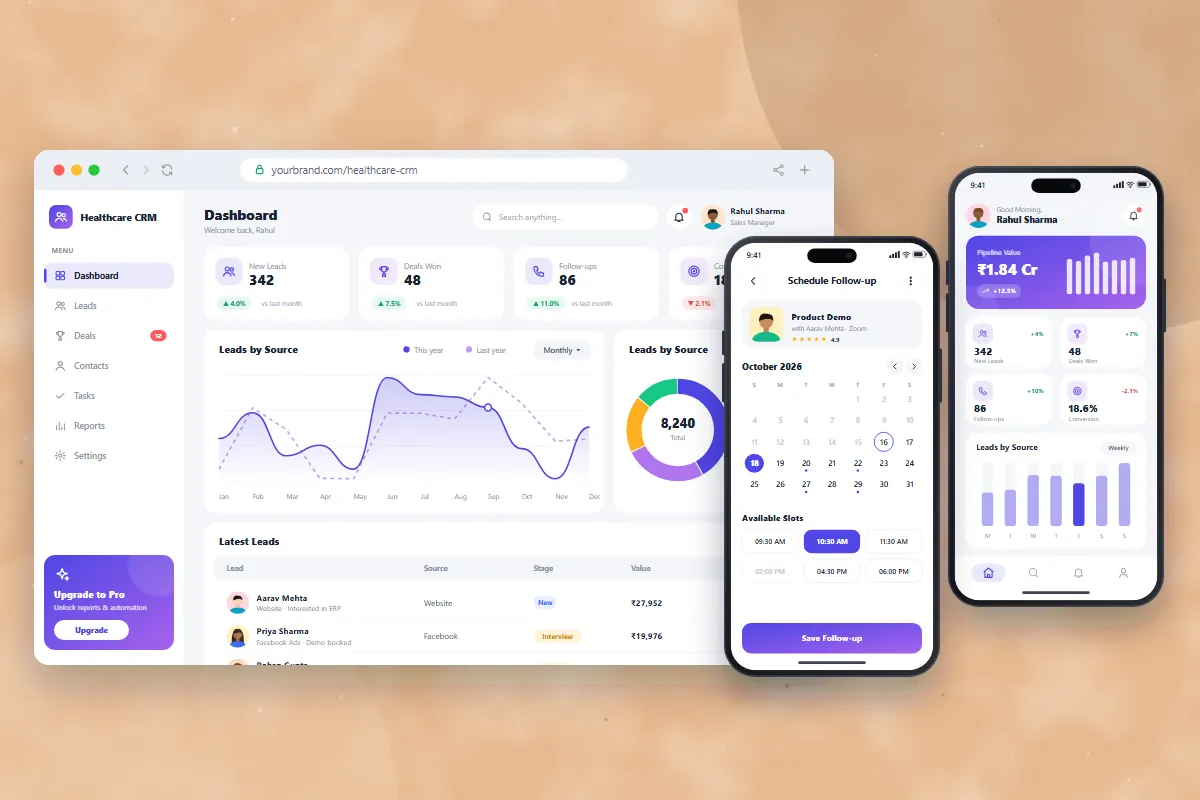 Healthcare CRM
 Online Form Builder
 Job Search Mobile App
 Property Dealer CRM
 AI Chatbot for Websites
 Quiz Application
 Real Estate Lead Management
 Social Media Management Platform
 Doctor Appointment Booking App
 Travel Agency CRM
 Job Portal Website
 Expense Management App
 Desktop CRM
 Online Course Selling Platform
 Property Booking App
Where this market is heading, and what we build for because of it.
Nigeria is Africa's largest fintech scene, where mobile-first design and resilient payment integrations decide success.
Business software in Lokoja is being rebuilt around APIs first, so the same data can feed a portal, a mobile app and a reporting dashboard.
Voice and conversational queries are pushing content toward plain, direct answers rather than keyword-stuffed paragraphs.
Expect accessibility to move from good practice to procurement requirement across most of this market within a few years.
Our CRM Development work maps to the sectors that actually drive this market.
The problems clients most often bring us — and how we deal with each one.
Locked-down builds force every small edit through a developer. We hand over a CMS your team can genuinely use.
Attractive layouts that bury the enquiry path convert badly. We design around the decision, not around the trend.
Payment, CRM and inventory links need error handling and retries. We test the failure paths, not just the happy path.
Plenty of businesses in Lokoja have a site nobody can update because the original developer stopped answering. We hand over full access, credentials and documentation as a matter of course.
Retrofitting SEO onto a finished build is expensive. Structure, schema and speed are handled during development.
Contact forms and payment flows in Lokoja get probed constantly. Validation, rate limiting and backups are part of the baseline, not extras.
The commercial reasons that come up most often in conversations with clients here.
Why CRM Development here needs a different approach from a generic build.
Before scoping any CRM Development work in Lokoja, it is worth being specific about what this market actually runs on. Lokoja sits inside Nigeria's wider economy, where Fintech, E-Commerce, Oil & Gas set the commercial pace and local firms compete for the same online attention.
Buyers here are high-energy and opportunity-led, with founders who move quickly once trust is established. Ignoring it produces a site that looks fine in a review meeting and converts poorly in the market.
The market is shaped by the fact that it is Africa's largest fintech scene, where mobile-first design and resilient payment integrations decide success. Plenty of businesses in Lokoja still have no properly optimised presence on Google, with heavy mobile and social discovery, which leaves qualified demand unclaimed.
Practical detail matters at this distance: pricing is presented in NGN (₦), our delivery overlaps with WAT (UTC+1), and communication runs in English. Search visibility work targets Google, with heavy mobile and social discovery.
Everything we deliver under CRM Development for businesses in Lokoja — each scoped and priced individually so you only pay for what you need.
Custom CRM Development delivered for Lokoja businesses, scoped in writing and built to scale with you.
Sales Pipeline Automation delivered for Lokoja businesses, scoped in writing and built to scale with you.
Lead Management System delivered for Lokoja businesses, scoped in writing and built to scale with you.
CRM Integration delivered for Lokoja businesses, scoped in writing and built to scale with you.
Customer Support Desk delivered for Lokoja businesses, scoped in writing and built to scale with you.
CRM Reporting & Dashboards delivered for Lokoja businesses, scoped in writing and built to scale with you.
A representative engagement, anonymised at the client's request.
A Logistics client operating in Lokoja was running on a platform built years earlier by a vendor they could no longer reach, and every small change needed a developer.
We built a role-based platform consolidating their operational data, automated the reconciliation work that had been manual, and exposed an API so reporting could be generated on demand.
Within two quarters the commercial picture had changed measurably, and the client moved onto a monthly retainer to keep improving rather than treating launch as the finish line.
The same sequence we follow on every CRM Development project in Lokoja, with a written checkpoint at each stage.
We map your goals, competitors in Lokoja and the questions your customers actually ask before buying.
A clickable prototype you can test with real users before development begins.
Brand-aligned interface design with an accessible type, colour and spacing system.
Modular build with role-based access, audit logging and third-party integrations.
Functional testing plus input validation, access control and backup verification.
Deployment, analytics verification, documentation and full credential handover.
Monthly reviews, A/B tests and prioritised improvements after launch.
The stack behind CRM Development projects we deliver in Lokoja — chosen for maintainability, not novelty.
What local data-protection law and the sector rules change about the build.
Anything that collects a name, an email or a payment in Nigeria sits under the data-protection law that applies in Nigeria. That is not a legal-department problem to solve after launch - it changes what the forms ask for, how consent is recorded and how long data is kept, so it belongs in the build.
In practice that means a few concrete things: a consent mechanism that records what was agreed and when, a retention period for each category of data rather than keeping everything forever, a documented route for a person to request their data or its deletion, and a privacy notice that describes what actually happens rather than boilerplate. Locally it also means accounting for local language and currency conventions.
Where you operate in a regulated sector, the baseline is not enough. PCI DSS governs card data, ISO 27001 and SOC 2 are what enterprise buyers in Lokoja will ask you to evidence, and health or financial data brings its own retention and audit-trail duties.
Accessibility applies to internal tools too, and it is where most fail. We build to WCAG 2.2 AA, which for admin software mostly means keyboard operability, honest form labelling and error messages that say what to do next.
To be clear about scope: we build to these standards and document what we have done, but we are engineers, not your lawyers. Anything with real regulatory exposure should be reviewed by someone qualified in Nigeria before you go live.
Honest ranges, and the three things that actually move them.
The question every buyer in Lokoja asks first is how long CRM Development takes, and the honest answer is a range rather than a date. For a first working module, plan on 8 to 12 weeks. For a full internal platform with roles and reporting, plan on 6 to 9 months. We commit to a date at the end of discovery, when it means something, rather than at the first call, when it cannot.
Schedules slip for predictable reasons: content that has not been written, approval chains nobody mapped, and an integration whose documentation turns out to be a phone number. We plan around all three rather than hoping.
We work to fortnightly milestones with something reviewable at each one. That means you know in week four whether the schedule is holding, instead of finding out in week twelve.
Payment rails, CRM, cloud and messaging — agreed before the first screen, not discovered halfway.
The integration surface is where CRM Development projects in Lokoja usually overrun. We settle it up front: what has to talk to what, which side owns the data, and what happens when one of them is unavailable.
On payments, the rails that matter in Nigeria are not the ones a generic template ships with. We work with Stripe, PayPal and local bank transfer, and pick between them on settlement time, fee structure and how much of the compliance burden the provider absorbs. Whether local bank transfer or PayPal is right for you depends on your average order value and your refund pattern, not on which is better known.
Beyond payments, internal software in Lokoja lives or dies on integration: accounting (Tally, Zoho Books, QuickBooks or Xero depending on the market), identity through Google Workspace or Microsoft Entra, storage and compute on AWS or Azure, and messaging through Twilio or the WhatsApp Business API. We map every one of those before committing to a data model.
Each connection ships with a written note on what it does, what it costs, and what breaks if it stops. That document has saved more Lokoja projects than any piece of code in them.
How we make sure the work we deliver actually surfaces in local search.
Being findable in Lokoja is a separate discipline from having a good CRM Development project, and the two are often confused. A well-built site that nobody finds is an expensive brochure.
The market is shaped by the fact that it is Africa's largest fintech scene, where mobile-first design and resilient payment integrations decide success. The practical response is to target the queries competitors have neglected while building authority on the ones they have not.
The work splits into three parts: technical health so pages can be indexed properly, content that answers the questions buyers in Lokoja actually type, and local signals such as profile accuracy and genuine reviews that drive map-pack visibility.
Plenty of businesses in Lokoja still have no properly optimised presence on Google, with heavy mobile and social discovery, which leaves qualified demand unclaimed. That gap does not stay open forever, which is the main argument for starting now rather than next year.
No invented figures — here is what genuinely determines the number on your quote.
We quote CRM Development in Lokoja in NGN (₦), itemised by deliverable. Before that quote exists, these are the factors we work through with you.
The second largest variable is content readiness. Projects where copy, images and data are ready move fast; projects waiting on content stretch, and stretched timelines cost money on both sides.
If the budget available does not match the scope discussed, we will say so and propose a smaller first phase rather than quietly cutting quality to fit the number.
Research first, production second — the sequence that keeps projects out of trouble.
The first week of any CRM Development project in Lokoja goes into research rather than production. We map competitor positioning, the questions buyers ask before they enquire, and the specific objections that stall deals in this market.
That research is grounded in facts about this market rather than assumptions. Lokoja sits inside Nigeria's wider economy, where Fintech, E-Commerce, Oil & Gas set the commercial pace and local firms compete for the same online attention. That mix determines what proof a page needs to carry before a Fintech or E-Commerce buyer will act on it.
On the build side, that translates into concrete decisions: how roles and permissions are modelled, which processes get automated first, what the audit trail records, and how the system behaves when an integration is unavailable. We design the data model for where your business in Lokoja expects to be in three years, not just for today's process.
Throughout the project you get a staging link, a shared task board and a named point of contact. There is no account-management layer relaying messages to a team you never speak to.
Pick the engagement model that fits how your business in Lokoja actually operates.
A smaller first release that earns revenue, then funded phases after it. Popular with businesses in Lokoja testing a new line.
Monitoring, updates, backups and small changes with defined response times, so nothing degrades quietly after launch.
Developers and designers working only on your roadmap, managed by us, reporting to you. For sustained multi-month programmes.
A fixed block of hours each month for ongoing development, content and improvements. Suits businesses that ship continuously.
What you actually get when you work with us, stated plainly.
Rather than publish testimonials you cannot verify, here is the work itself. Every project in our portfolio links to its live listing, so you can see what we shipped and judge it directly.
Gletus Technology is a single IT partner for Lokoja — explore what else we deliver here.
We deliver CRM Development across Nigeria and the surrounding market:
We also work with clients further afield:
Not sure whether we cover your area? See where we work across Delhi NCR — our office, the cities we serve, and how remote and on-site delivery works.
The questions we hear most from businesses searching for CRM Development in Lokoja.
CRM Development in Lokoja — answered directly.
Gletus Technology Pvt Ltd is an established CRM Development company serving Lokoja, with years of delivery experience and an in-house team covering strategy, design, development, QA and support. Rather than claiming a title, we would suggest judging any vendor in Lokoja on three things: relevant work you can actually inspect, a written scope, and whether you get direct access to the people building your project.
Wherever possible those accounts are opened in your name and billed to you directly, so you retain control and can see exactly what infrastructure costs. We will recommend and configure the setup, but we do not sit in the middle of your hosting relationship.
There is no official ranking, and any list claiming to be one is usually paid placement. A more useful approach in Lokoja is to shortlist three suppliers, ask each for live URLs and a written scope, and compare what is actually included rather than comparing headline prices.
More questions we are asked about CRM Development in Lokoja:
Usually not the visible design - it is what sits behind it. Cheaper work typically skips cross-device testing, performance budgets, security updates, structured content and post-launch support. Those omissions are invisible on day one and expensive in month six.
Gletus Technology works across Lokoja and the wider Nigeria region. Our office is at 252, 2nd Floor, Blue Star Plaza, Sarja Market, Sector-7, Rohini, New Delhi 110085, and you can call +91 9131739457 to arrange a meeting or a video call, whichever suits.
That is worth checking rather than taking on trust. Ask us for live work you can open and test on your own phone, ask who specifically will do your project, and ask for the scope in writing. We will answer all three directly. Any supplier that will not is telling you something useful.
You do - completely. Source code, hosting, domain, analytics and any third-party accounts are transferred to your ownership at handover, with credentials and documentation. You are never locked into us to make changes.
No. Templates are cheap up front and expensive later, because the first genuinely custom requirement forces a rebuild. We design around your actual workflows and hand over clean, documented code you own outright.
A conversation about goals, whatever brand assets exist, and one decision-maker who can approve at each milestone. Content can be developed alongside the build - missing content is the single most common cause of delay, so we plan for it from the start.
That is the point of building custom. We design the data model and module boundaries for where you expect to be in three years, so adding users, locations or modules is configuration work rather than a rewrite.
Role-based access control, encrypted credentials, audit logging, input validation and scheduled backups are part of the baseline build. For regulated sectors we scope the specific compliance requirements during discovery rather than assuming a generic standard.
Yes - accounting, CRM, payment gateways, logistics and messaging platforms are all common. We check API availability during discovery, because an integration that looked simple in a sales meeting occasionally turns out to have no public API at all.
Three practical things: an in-house team rather than a subcontractor chain, written scope and pricing before work begins, and full handover of code and accounts at launch. The market is shaped by the fact that it is Africa's largest fintech scene, where mobile-first design and resilient payment integrations decide success.
Usually yes, and often more so - a competitor already ranking proves the demand exists and is capturable. The market is shaped by the fact that it is Africa's largest fintech scene, where mobile-first design and resilient payment integrations decide success. The route in is rarely a head-on fight; it is the specific queries they have neglected.
Buyers here are high-energy and opportunity-led, with founders who move quickly once trust is established. That is not a guess we make at proposal stage - it comes from delivering work in this market and watching what converts.
For clients in Nigeria we work with Stripe, PayPal and local bank transfer. The right choice depends on your average order value, refund pattern and settlement timing rather than brand familiarity - at low volume Stripe is usually the practical default, and we will say plainly when a cheaper provider would cost you more in reconciliation time. Card details always go straight to the gateway, so your system stores a token rather than a card number.
You do, entirely - source code, database, design files, and every account we register on your behalf. Gateway, analytics and hosting accounts go in your name with you as owner and us added as a user, so if you stop working with us nothing needs re-registering and no service is interrupted. There is no fee to leave and no licence retained.
A first working module is typically 8 to 12 weeks; a full internal platform with roles and reporting runs 6 to 9 months. What moves those dates is rarely the engineering - it is how quickly content arrives, how many people must approve a decision, and whether a third-party system turns out to be documented. We commit to a date at the end of discovery, when it means something, rather than on the first call.
We build to WCAG 2.2 AA: semantic headings, form controls with real labels, keyboard-operable navigation, a visible focus state, sufficient colour contrast, and no meaning carried by colour alone. It widens the audience you can sell to in Lokoja, it is increasingly what procurement asks about, and it overlaps almost entirely with what search engines reward anyway.
Yes - accounting (Tally, Zoho Books, QuickBooks or Xero), identity through Google Workspace or Microsoft Entra, storage and compute on AWS or Azure, and messaging through Twilio or the WhatsApp Business API. Every connection is documented with its credentials, rate limits and failure behaviour, and the accounts are registered in your name so nothing goes dark if you change supplier.
The published standards our CRM Development work is built against.
Related searches
Send us your requirements for CRM Development in Lokoja and get an itemised proposal within two working days.
Gletus Technology delivers Website Development, Mobile App Development, Software Development & Digital Marketing services to businesses and startups across Delhi, Noida, Greater Noida, Gurugram, Faridabad & Ghaziabad. Pick your area below — we are just a call away.
From our blog
Practical guides from the Gletus team on what projects cost, which technology fits, and how to grow your business online.
What an Android or iOS app actually costs to build in India, why quotes differ so widely, and the questions that make a quote comparable.

PHP, Node, Python, React, Flutter - how to decide what your project should be built in, without relying on whichever the agency happens to prefer.

The steps that actually move a business into the local map results, in the order worth doing them, with the common Indian mistakes called out.
Gletus leverages the latest web and mobile technologies to ensure every product we deliver is modern, high-performing, and aligned with industry standards.