


Cost guides
Mobile App Development Cost in India: What Drives the Price
What an Android or iOS app actually costs to build in India, why quotes differ so widely, and the questions that make a quote comparable.

Gletus Technology is a trusted SaaS Development company in Malaysia, delivering multi-tenant SaaS products with billing and roles for startups, SMEs and established businesses. We help companies in Malaysia win more customers online with work that is built to perform, not just to look good.
Gletus Technology Pvt Ltd is a SaaS Development company serving Malaysia. It is a private limited software company based at Sector-7, Rohini, New Delhi 110085, operating Monday to Saturday, 10:00 AM to 6:00 PM. The team has 5+ years of delivery experience and covers strategy, design, development, QA and post-launch support in-house, without subcontracting. Work in this area typically covers SaaS MVP Development, Multi-Tenant Architecture, Subscription Billing Integration, Role and Permission Systems. Typical clients in Malaysia include Manufacturing & Electronics, Palm Oil & Agri, Tourism businesses. Buyers here are multilingual and value-conscious, with SMEs that want quick launches and low running costs. Engagements start with a written scope and itemised pricing in MYR, and code, hosting and analytics accounts transfer to client ownership at handover. Delivery is remote, with work scheduled around the client's timezone. Contact: +91 9131739457 / info@gletus.com.
Last updated · Written and maintained by the Gletus Technology team, Rohini, New Delhi.
Malaysia is a national market built on Manufacturing & Electronics, Palm Oil & Agri, Tourism. That single fact shapes what SaaS Development needs to achieve here, and it is where every Gletus project in Malaysia begins.
Gletus Technology brings 5+ years of delivery experience to every SaaS Development engagement in Malaysia. We are deliberately a build-and-support partner rather than a launch-and-vanish agency, and our maintenance retainers reflect that.
For software projects that means clear data models, role-based access, audit trails and integrations that survive contact with your existing systems.
New build or rescue project, our commitment in Malaysia is identical - multi-tenant SaaS products with billing and roles, delivered on a schedule you can plan around.
Whether you searched for SaaS Development, software-as-a-service development, or SaaS application development, you are looking for the same thing. We use the short form on this page for readability, but the service is identical.
Our Portfolio
A sample of the software in our portfolio — the same standard we apply to every project in Malaysia. Open any project to see its features, workflow and pricing.
 Survey & Feedback SaaS
 Online Form Builder
 Project Management App
 White-Label Software
 Website Builder
 Customer Support App
 Project Management Software
 Landing Page Builder
 Grocery Delivery App
 Task Management Software
 No-Code Platform
 Food Delivery App
 Project Management SaaS
 Lead Generation Landing Pages
 WhatsApp AI Chatbot
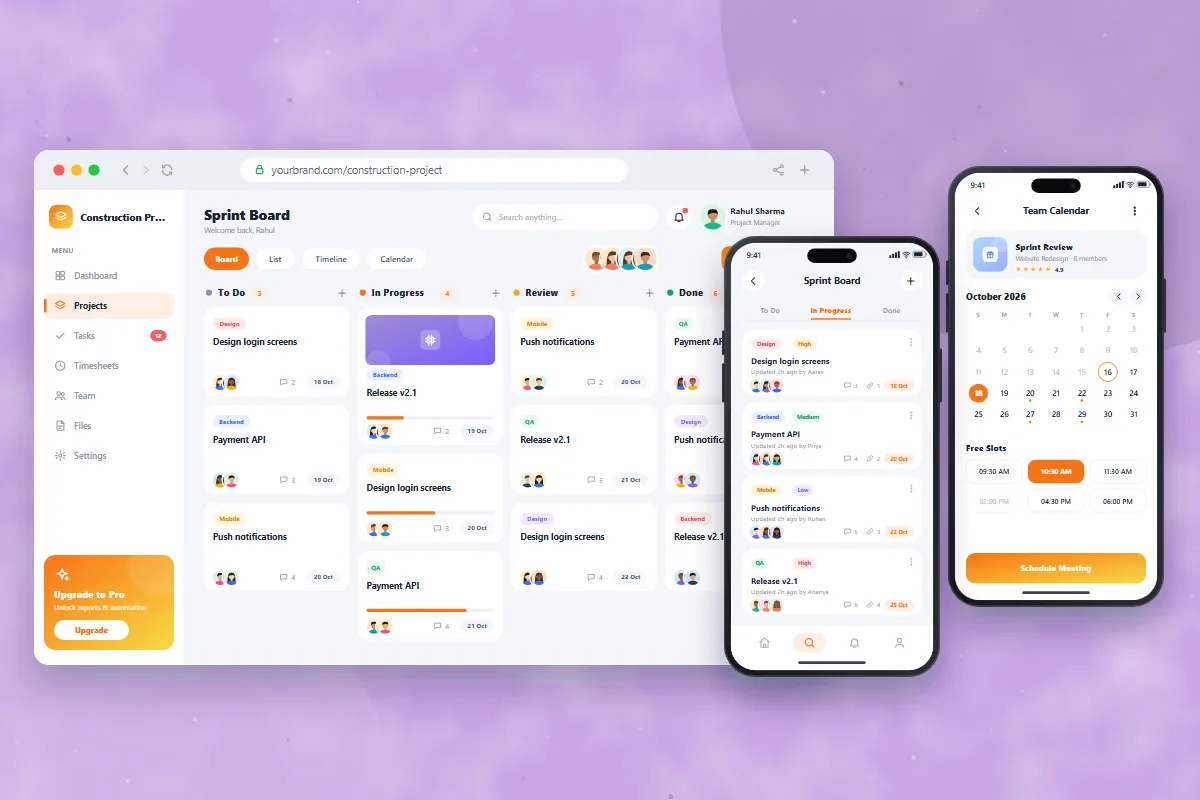 Construction Project Management
 Project Management Portal
 Job Search Mobile App
 Contractor Management Software
 Customer Support Portal
 Quiz Application
 Construction Estimation Software
 Food Delivery Website
 Doctor Appointment Booking App
 Cross-Platform Desktop App
 Single-vendor eCommerce Website
 Expense Management App
 Complaint Management System
 Multi-Store Management Software
 Property Booking App
Our SaaS Development work maps to the sectors that actually drive this market.
Why SaaS Development here needs a different approach from a generic build.
Before scoping any SaaS Development work in Malaysia, it is worth being specific about what this market actually runs on. Malaysia's economy is led by Manufacturing & Electronics, Palm Oil & Agri, Tourism, Retail, and companies across all of them now compete first on how easily customers can find and transact with them online.
Buyers here are multilingual and value-conscious, with SMEs that want quick launches and low running costs. That behaviour has direct design consequences: it decides what belongs above the fold, how much proof a page needs, and where the enquiry form should sit.
The market is shaped by the fact that it is strong e-wallet and marketplace adoption, with multilingual sites often outranking single-language competitors. Plenty of businesses in Malaysia still have no properly optimised presence on Google, across English, Malay and Chinese queries, which leaves qualified demand unclaimed.
Practical detail matters at this distance: pricing is presented in MYR (RM), our delivery overlaps with MYT (UTC+8), and communication runs in English, Malay & Chinese. Search visibility work targets Google, across English, Malay and Chinese queries.
The commercial reasons that come up most often in conversations with clients here.
The problems clients most often bring us — and how we deal with each one.
Plenty of businesses in Malaysia have a site nobody can update because the original developer stopped answering. We hand over full access, credentials and documentation as a matter of course.
Scope creep is usually a symptom of vague discovery. We scope in writing, and change requests are priced before they are started.
Retrofitting SEO onto a finished build is expensive. Structure, schema and speed are handled during development.
Contact forms and payment flows in Malaysia get probed constantly. Validation, rate limiting and backups are part of the baseline, not extras.
Heavy builds waste ad spend and lose mobile users in Malaysia. Performance budgets are set at the start of the project, not audited after complaints.
Locked-down builds force every small edit through a developer. We hand over a CMS your team can genuinely use.
Where this market is heading, and what we build for because of it.
Malaysia is strong e-wallet and marketplace adoption, with multilingual sites often outranking single-language competitors.
Business software in Malaysia is being rebuilt around APIs first, so the same data can feed a portal, a mobile app and a reporting dashboard.
AI answer engines now sit between the search box and the click, which rewards factual, well-structured pages and penalises padded content.
Privacy expectations keep tightening, and consent-aware analytics is becoming the default rather than a compliance exercise.
Everything we deliver under SaaS Development for businesses in Malaysia — each scoped and priced individually so you only pay for what you need.
SaaS MVP Development delivered for Malaysia businesses, scoped in writing and built to scale with you.
Multi-Tenant Architecture delivered for Malaysia businesses, scoped in writing and built to scale with you.
Subscription Billing Integration delivered for Malaysia businesses, scoped in writing and built to scale with you.
Role and Permission Systems delivered for Malaysia businesses, scoped in writing and built to scale with you.
SaaS Analytics Dashboards delivered for Malaysia businesses, scoped in writing and built to scale with you.
White-Label SaaS Platforms delivered for Malaysia businesses, scoped in writing and built to scale with you.
An illustration of how this kind of work usually goes — not a specific client. For real projects you can open and check, see our portfolio.
Tourism businesses in Malaysia often come to us when they have solid word of mouth in Malaysia but little search visibility, so growth stalls whenever referrals slow down.
We usually build a role-based platform that brings operational data together, automate the reconciliation work that was manual, and expose an API so reports can be generated on demand.
The same sequence we follow on every SaaS Development project in Malaysia, with a written checkpoint at each stage.
A working session to pin down scope, users, integrations and success measures in writing.
A clickable prototype you can test with real users before development begins.
Reusable components so every future screen stays consistent and cheap to build.
Modular build with role-based access, audit logging and third-party integrations.
Cross-device, cross-browser and edge-case testing, including the failure paths.
Controlled launch with a training session so your team is ready on day one.
Ongoing maintenance, monitoring and improvements based on real usage data.
The stack behind SaaS Development projects we deliver in Malaysia — chosen for maintainability, not novelty.
Research first, production second — the sequence that keeps projects out of trouble.
We do not begin SaaS Development work in Malaysia from a template library. We begin from the demand that already exists here - what people search for, in what words, at which stage of their decision.
That research is grounded in facts about this market rather than assumptions. Malaysia's economy is led by Manufacturing & Electronics, Palm Oil & Agri, Tourism, Retail, and companies across all of them now compete first on how easily customers can find and transact with them online. So the priorities we set for Manufacturing & Electronics and Palm Oil & Agri clients here look nothing like the priorities we would set in a different market.
On the build side, that translates into concrete decisions: how roles and permissions are modelled, which processes get automated first, what the audit trail records, and how the system behaves when an integration is unavailable. We design the data model for where your business in Malaysia expects to be in three years, not just for today's process.
Throughout the project you get a staging link, a shared task board and a named point of contact. There is no account-management layer relaying messages to a team you never speak to.
What the PDPA and the sector rules change about the build.
A SaaS Development project serving customers in Malaysia has to account for the Personal Data Protection Act 2010. We treat that as a design input rather than a disclaimer bolted on at the end, because retrofitting consent and retention into a finished system is far more expensive than building it in.
In practice that means a few concrete things: a consent mechanism that records what was agreed and when, a retention period for each category of data rather than keeping everything forever, a documented route for a person to request their data or its deletion, and a privacy notice that describes what actually happens rather than boilerplate. Locally it also means accounting for Bahasa Malaysia content alongside English for public-facing pages.
Where you operate in a regulated sector, the baseline is not enough. PCI DSS governs card data, ISO 27001 and SOC 2 are what enterprise buyers in Malaysia will ask you to evidence, and health or financial data brings its own retention and audit-trail duties.
Accessibility applies to internal tools too, and it is where most fail. We build to WCAG 2.2 AA, which for admin software mostly means keyboard operability, honest form labelling and error messages that say what to do next.
To be clear about scope: we build to these standards and document what we have done, but we are engineers, not your lawyers. Anything with real regulatory exposure should be reviewed by someone qualified in Malaysia before you go live.
How we make sure the work we deliver actually surfaces in local search.
Whatever we build for you, it still has to be found by people in Malaysia who do not yet know your name. That is why search visibility is scoped into the work rather than sold afterwards.
The market is shaped by the fact that it is strong e-wallet and marketplace adoption, with multilingual sites often outranking single-language competitors. We treat that as the starting position rather than a reason to avoid the market.
Plenty of businesses in Malaysia still have no properly optimised presence on Google, across English, Malay and Chinese queries, which leaves qualified demand unclaimed. Gaps like that close once one competitor takes them seriously, so timing matters more than budget here.
Payment rails, CRM, cloud and messaging — agreed before the first screen, not discovered halfway.
Almost nothing we build for Malaysia stands on its own. A SaaS Development project earns its keep when it is wired into the systems the business already runs on - so the integration list is agreed before the first screen is designed, not discovered halfway through.
On payments, the rails that matter in Malaysia are not the ones a generic template ships with. We work with FPX, iPay88, Billplz and GrabPay, and pick between them on settlement time, fee structure and how much of the compliance burden the provider absorbs. Whether iPay88 or Billplz is right for you depends on your average order value and your refund pattern, not on which is better known.
Beyond payments, internal software in Malaysia lives or dies on integration: accounting (Tally, Zoho Books, QuickBooks or Xero depending on the market), identity through Google Workspace or Microsoft Entra, storage and compute on AWS or Azure, and messaging through Twilio or the WhatsApp Business API. We map every one of those before committing to a data model.
Each connection ships with a written note on what it does, what it costs, and what breaks if it stops. That document has saved more Malaysia projects than any piece of code in them.
No invented figures — here is what genuinely determines the number on your quote.
Pricing for SaaS Development in Malaysia varies more with complexity than with location. Rather than publish a headline figure that would be wrong for most projects, here is what genuinely drives the number on your quote.
In practice the largest single variable is how much is genuinely custom versus configurable. Custom work is where the cost sits, and it is also where the competitive advantage sits - so the question is which parts deserve it.
We also scope in phases where budget is tight. A focused first release that earns revenue is almost always better than a complete build delayed by six months, and businesses in Malaysia rarely regret starting smaller.
Honest ranges, and the three things that actually move them.
The question every buyer in Malaysia asks first is how long SaaS Development takes, and the honest answer is a range rather than a date. For a first working module, plan on 8 to 12 weeks. For a full internal platform with roles and reporting, plan on 6 to 9 months. A firm date offered before scope is agreed is a marketing number. We will give you one once we know what we are building.
What moves that timeline is rarely the engineering. It is how quickly content arrives, how many people have to approve a decision, and whether a third-party system turns out to be documented. Those three account for most of the overruns we have seen in Malaysia.
Progress is visible rather than reported: a staging link updated continuously, and a reviewable increment every two weeks. Slippage shows up early enough to do something about it.
Pick the engagement model that fits how your business in Malaysia actually operates.
Best when requirements are clear. Written scope, fixed price, milestone schedule. Change requests are quoted separately so the approved number holds.
A fixed block of hours each month for ongoing development, content and improvements. Suits businesses that ship continuously.
A smaller first release that earns revenue, then funded phases after it. Popular with businesses in Malaysia testing a new line.
Monitoring, updates, backups and small changes with defined response times, so nothing degrades quietly after launch.
What you actually get when you work with us, stated plainly.
Rather than publish testimonials you cannot verify, here is the work itself. Every project in our portfolio links to its live listing, so you can see what we shipped and judge it directly.
Gletus Technology is a single IT partner for Malaysia — explore what else we deliver here.
Our home market, served from our office in Rohini, New Delhi:
We deliver SaaS Development across Malaysia and the surrounding market:
We also work with clients further afield:
Not sure whether we cover your area? See where we work across Delhi NCR — our office, the cities we serve, and how remote and on-site delivery works. Or browse every area we cover in Malaysia.
The questions we hear most from businesses searching for SaaS Development in Malaysia.
SaaS Development in Malaysia — answered directly.
Gletus Technology Pvt Ltd is an established SaaS Development company serving Malaysia, with years of delivery experience and an in-house team covering strategy, design, development, QA and support. Rather than claiming a title, we would suggest judging any vendor in Malaysia on three things: relevant work you can actually inspect, a written scope, and whether you get direct access to the people building your project.
Yes. We work with clients in Malaysia and across Malaysia remotely, with overlapping hours against MYT (UTC+8) and communication in English, Malay & Chinese. Delivery runs on shared project boards, scheduled calls and staging links, so distance does not reduce visibility.
We start with an audit rather than a sales pitch - performance, structure, security, search visibility and conversion. Often the foundation is sound and targeted fixes cost a fraction of a rebuild. Where a rebuild genuinely is cheaper over two years, we will show you that arithmetic.
More questions we are asked about SaaS Development in Malaysia:
We have delivered projects for Manufacturing & Electronics, Palm Oil & Agri and Tourism businesses among others, which reflects the commercial mix here. Malaysia's economy is led by Manufacturing & Electronics, Palm Oil & Agri, Tourism, Retail, and companies across all of them now compete first on how easily customers can find and transact with them online.
You do - completely. Source code, hosting, domain, analytics and any third-party accounts are transferred to your ownership at handover, with credentials and documentation. You are never locked into us to make changes.
Cost depends on scope rather than location. A focused launch project is priced very differently from a multi-module platform with integrations. What we do commit to in Malaysia is an itemised quote in MYR (RM) before work starts, with change requests priced separately so the number you approve is the number you pay. Send us your requirements and you will have a written breakdown within two working days.
A tightly scoped project typically runs four to eight weeks; larger builds with custom integrations run three to five months. The variable that moves timelines most is not development speed - it is how quickly content, approvals and third-party access come back from your side. We publish a milestone schedule at kickoff so both sides can see slippage early.
Yes. We regularly take a defined workstream alongside an internal team - a module, a redesign or the search and performance work. Boundaries and code review conventions are agreed up front so nobody is working over the top of anyone else.
Success measures are agreed before development starts - enquiries, qualified leads, bookings, orders or whatever maps to your commercial goal. Analytics and conversion tracking are configured before launch, so the first month's data is usable rather than retrospective guesswork.
Yes - accounting, CRM, payment gateways, logistics and messaging platforms are all common. We check API availability during discovery, because an integration that looked simple in a sales meeting occasionally turns out to have no public API at all.
That is the point of building custom. We design the data model and module boundaries for where you expect to be in three years, so adding users, locations or modules is configuration work rather than a rewrite.
Role-based access control, encrypted credentials, audit logging, input validation and scheduled backups are part of the baseline build. For regulated sectors we scope the specific compliance requirements during discovery rather than assuming a generic standard.
Three practical things: an in-house team rather than a subcontractor chain, written scope and pricing before work begins, and full handover of code and accounts at launch. The market is shaped by the fact that it is strong e-wallet and marketplace adoption, with multilingual sites often outranking single-language competitors.
Demand tracks the local economy closely. Malaysia's economy is led by Manufacturing & Electronics, Palm Oil & Agri, Tourism, Retail, and companies across all of them now compete first on how easily customers can find and transact with them online. Those are the sectors we field the most enquiries from here.
Buyers here are multilingual and value-conscious, with SMEs that want quick launches and low running costs. That is not a guess we make at proposal stage - it comes from delivering work in this market and watching what converts.
For clients in Malaysia we work with FPX, iPay88, Billplz and GrabPay. The right choice depends on your average order value, refund pattern and settlement timing rather than brand familiarity - at low volume FPX is usually the practical default, and we will say plainly when a cheaper provider would cost you more in reconciliation time. Card details always go straight to the gateway, so your system stores a token rather than a card number.
A first working module is typically 8 to 12 weeks; a full internal platform with roles and reporting runs 6 to 9 months. What moves those dates is rarely the engineering - it is how quickly content arrives, how many people must approve a decision, and whether a third-party system turns out to be documented. We commit to a date at the end of discovery, when it means something, rather than on the first call.
If you collect a name, an email or a payment from someone in Malaysia, the Personal Data Protection Act 2010 applies. In practice that means recorded consent rather than assumed consent, a stated retention period for each type of data, a working route for access and deletion requests, and a privacy notice that describes what actually happens. Locally it also means accounting for Bahasa Malaysia content alongside English for public-facing pages. We build and document to that standard; a formal compliance opinion should come from a qualified adviser in Malaysia.
You do, entirely - source code, database, design files, and every account we register on your behalf. Gateway, analytics and hosting accounts go in your name with you as owner and us added as a user, so if you stop working with us nothing needs re-registering and no service is interrupted. There is no fee to leave and no licence retained.
Yes - accounting (Tally, Zoho Books, QuickBooks or Xero), identity through Google Workspace or Microsoft Entra, storage and compute on AWS or Azure, and messaging through Twilio or the WhatsApp Business API. Every connection is documented with its credentials, rate limits and failure behaviour, and the accounts are registered in your name so nothing goes dark if you change supplier.
The published standards our SaaS Development work is built against.
Related searches
A short call is usually enough to scope a realistic budget and timeline for your Malaysia project.
Gletus Technology delivers Website Development, Mobile App Development, Software Development & Digital Marketing services to businesses and startups across Delhi, Noida, Greater Noida, Gurugram, Faridabad & Ghaziabad. Pick your area below — we are just a call away.
From our blog
Practical guides from the Gletus team on what projects cost, which technology fits, and how to grow your business online.
What an Android or iOS app actually costs to build in India, why quotes differ so widely, and the questions that make a quote comparable.

PHP, Node, Python, React, Flutter - how to decide what your project should be built in, without relying on whichever the agency happens to prefer.

The steps that actually move a business into the local map results, in the order worth doing them, with the common Indian mistakes called out.
Gletus leverages the latest web and mobile technologies to ensure every product we deliver is modern, high-performing, and aligned with industry standards.