



Cost guides
Mobile App Development Cost in India: What Drives the Price
What an Android or iOS app actually costs to build in India, why quotes differ so widely, and the questions that make a quote comparable.

Looking for Logistics App Development in Panaji that actually moves the numbers? Gletus Technology delivers fleet, delivery and supply-chain apps, backed by years of hands-on delivery and support that does not disappear after launch.
Gletus Technology Pvt Ltd is a Logistics App Development company serving Panaji, India. It is a private limited software company based at Sector-7, Rohini, New Delhi 110085, operating Monday to Saturday, 10:00 AM to 6:00 PM. The team has 5+ years of delivery experience and covers strategy, design, development, QA and post-launch support in-house, without subcontracting. Work in this area typically covers Fleet Management Apps, Delivery Tracking, Route Optimisation, Driver Applications. Typical clients in Panaji include IT & Software, Retail & Trading, Manufacturing businesses. Buyers here are relationship-led, price-sensitive and fast-moving, with decisions often made directly by the founder or promoter. Engagements start with a written scope and itemised pricing in INR, and code, hosting and analytics accounts transfer to client ownership at handover. Delivery is remote by default with in-person meetings across Delhi NCR where a project needs them. Contact: +91 9131739457 / info@gletus.com.
Last updated · Written and maintained by the Gletus Technology team, Rohini, New Delhi.
Choosing a Logistics App Development company in Panaji is really a decision about who understands your customers. Panaji is a business centre within India, and the businesses that do well here are the ones whose digital presence matches how people in this market actually search, compare and decide.
Gletus Technology brings 5+ years of delivery experience to every Logistics App Development engagement in Panaji. We are deliberately a build-and-support partner rather than a launch-and-vanish agency, and our maintenance retainers reflect that.
For web projects that means Core Web Vitals treated as a requirement, semantic markup that search engines can parse, and a CMS your own team can operate without calling us every week.
New build or rescue project, our commitment in Panaji is identical - fleet, delivery and supply-chain apps, delivered on a schedule you can plan around.
Whether you searched for Logistics App Development, transport and logistics app development, or fleet management app development, you are looking for the same thing. We use the short form on this page for readability, but the service is identical.
Our Portfolio
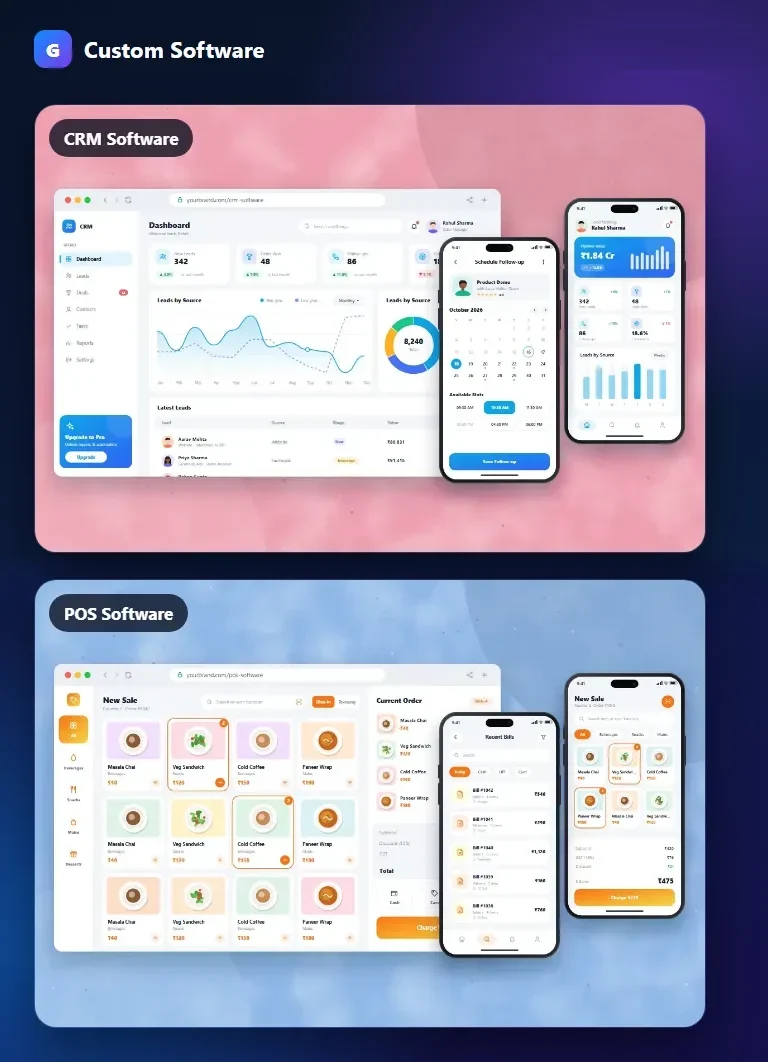
A sample of the websites and platforms in our portfolio — the same standard we apply to every project in Panaji. Open any project to see its features, workflow and pricing.
 Food Delivery Website
 Grocery Delivery App
 Restaurant Online Ordering System
 Single-vendor eCommerce Website
 Food Delivery App
 CRM Software
 Multi-Store Management Software
 WhatsApp AI Chatbot
 CRM SaaS
 Online Form Builder
 Job Search Mobile App
 AI Voice Calling Agent
 AI Chatbot for Websites
 Quiz Application
 SEO Campaign Management
 Social Media Management Platform
 Doctor Appointment Booking App
 Applicant Tracking System (ATS)
 Job Portal Website
 Expense Management App
 Learning Management System (LMS)
 Online Course Selling Platform
 Property Booking App
 Electronic Medical Records (EMR)
 Telemedicine Platform
 Bike Taxi App
 Insurance CRM
 Insurance Broker Portal
 Social Networking App
 Property Dealer CRM
Why Logistics App Development here needs a different approach from a generic build.
Panaji does not behave like a generic market, and Logistics App Development that ignores that tends to underperform. Panaji sits inside India's wider economy, where IT & Software, Retail & Trading, Manufacturing set the commercial pace and local firms compete for the same online attention.
Buyers here are relationship-led, price-sensitive and fast-moving, with decisions often made directly by the founder or promoter. That behaviour has direct design consequences: it decides what belongs above the fold, how much proof a page needs, and where the enquiry form should sit.
The market is shaped by the fact that it is one of the fastest-growing digital economies in the world, with UPI payments, cheap mobile data and mobile-first buyers. Plenty of businesses in Panaji still have no properly optimised presence on Google, which handles the overwhelming majority of searches in India, which leaves qualified demand unclaimed.
Our Logistics App Development work maps to the sectors that actually drive this market.
The problems clients most often bring us — and how we deal with each one.
Locked-down builds force every small edit through a developer. We hand over a CMS your team can genuinely use.
Retrofitting SEO onto a finished build is expensive. Structure, schema and speed are handled during development.
A recoloured theme is easy to spot and hard to extend. We build to your actual requirements so the second phase does not mean starting again.
If analytics and goals are not configured, nobody can tell what worked. We set up tracking before launch, not months later.
Contact forms and payment flows in Panaji get probed constantly. Validation, rate limiting and backups are part of the baseline, not extras.
Scope creep is usually a symptom of vague discovery. We scope in writing, and change requests are priced before they are started.
Where this market is heading, and what we build for because of it.
India is one of the fastest-growing digital economies in the world, with UPI payments, cheap mobile data and mobile-first buyers.
Web projects in Panaji are moving toward component-driven front ends and headless content, which makes redesigns incremental instead of catastrophic.
AI answer engines now sit between the search box and the click, which rewards factual, well-structured pages and penalises padded content.
Expect accessibility to move from good practice to procurement requirement across most of this market within a few years.
The commercial reasons that come up most often in conversations with clients here.
Everything we deliver under Logistics App Development for businesses in Panaji — each scoped and priced individually so you only pay for what you need.
Fleet Management Apps delivered for Panaji businesses, scoped in writing and built to scale with you.
Delivery Tracking delivered for Panaji businesses, scoped in writing and built to scale with you.
Route Optimisation delivered for Panaji businesses, scoped in writing and built to scale with you.
Driver Applications delivered for Panaji businesses, scoped in writing and built to scale with you.
Warehouse Management delivered for Panaji businesses, scoped in writing and built to scale with you.
Proof of Delivery delivered for Panaji businesses, scoped in writing and built to scale with you.
An illustration of how this kind of work usually goes — not a specific client. For real projects you can open and check, see our portfolio.
IT & Software businesses in Panaji often come to us when they are running on a platform built years ago by a vendor they can no longer reach, so every small change needs a developer.
We usually set a performance budget, restructure the site around how buyers actually search, add schema markup and move content editing into a CMS your own team can run.
The same sequence we follow on every Logistics App Development project in Panaji, with a written checkpoint at each stage.
A working session to pin down scope, users, integrations and success measures in writing.
User journeys, screen inventory and edge cases documented so nothing is discovered late.
Brand-aligned interface design with an accessible type, colour and spacing system.
Semantic, standards-based build with performance budgets enforced throughout.
Functional testing plus input validation, access control and backup verification.
Deployment, analytics verification, documentation and full credential handover.
Monthly reviews, A/B tests and prioritised improvements after launch.
The stack behind Logistics App Development projects we deliver in Panaji — chosen for maintainability, not novelty.
Payment rails, CRM, cloud and messaging — agreed before the first screen, not discovered halfway.
Logistics App Development work in Panaji is rarely a greenfield exercise. There is usually an existing payment arrangement, an accounting package and a pile of spreadsheets, and the build has to meet all three where they are.
On payments, the rails that matter in India are not the ones a generic template ships with. We work with UPI, Razorpay, PayU, Cashfree, CCAvenue, Paytm and PhonePe, and pick between them on settlement time, fee structure and how much of the compliance burden the provider absorbs. We will tell you plainly where UPI costs less than PhonePe at your volume, and where the cheaper option costs more in reconciliation time.
Beyond payments, a site in Panaji usually has to reach a CRM, an email platform and an analytics stack. We integrate Zoho, Salesforce, HubSpot, Freshworks and Pipedrive on the CRM side; Mailchimp, SendGrid or Brevo for email; Google Analytics 4 and Google Tag Manager for measurement; and Google Maps Platform where location matters to the customer.
Each connection ships with a written note on what it does, what it costs, and what breaks if it stops. That document has saved more Panaji projects than any piece of code in them.
Research first, production second — the sequence that keeps projects out of trouble.
We do not begin Logistics App Development work in Panaji from a template library. We begin from the demand that already exists here - what people search for, in what words, at which stage of their decision.
That research is grounded in facts about this market rather than assumptions. Panaji sits inside India's wider economy, where IT & Software, Retail & Trading, Manufacturing set the commercial pace and local firms compete for the same online attention. That mix determines what proof a page needs to carry before an IT & Software or Retail & Trading buyer will act on it.
On the build side, that translates into concrete decisions: what belongs above the fold, how deep the URL structure goes, which pages carry schema markup, and what the page-weight ceiling is on a mid-range Android device. We test on the hardware your customers in Panaji actually use rather than on a developer's flagship phone.
Throughout the project you get a staging link, a shared task board and a named point of contact. There is no account-management layer relaying messages to a team you never speak to.
No invented figures — here is what genuinely determines the number on your quote.
The honest answer to what Logistics App Development costs in Panaji is that it depends on scope, and any firm quoting a fixed number before understanding your requirements is guessing. What we can do is be transparent about what actually moves the price.
One thing we do not do is quote low and recover it through change requests. Scope is written down, and anything outside it is priced and approved before work starts on it.
We also scope in phases where budget is tight. A focused first release that earns revenue is almost always better than a complete build delayed by six months, and businesses in Panaji rarely regret starting smaller.
What the DPDP Act and the sector rules change about the build.
A Logistics App Development project serving customers in Panaji has to account for the Digital Personal Data Protection Act, 2023. We treat that as a design input rather than a disclaimer bolted on at the end, because retrofitting consent and retention into a finished system is far more expensive than building it in.
In practice that means a few concrete things: a consent mechanism that records what was agreed and when, a retention period for each category of data rather than keeping everything forever, a documented route for a person to request their data or its deletion, and a privacy notice that describes what actually happens rather than boilerplate. Locally it also means accounting for RBI card-tokenisation rules, which mean you cannot store raw card numbers yourself.
Honest ranges, and the three things that actually move them.
The question every buyer in Panaji asks first is how long Logistics App Development takes, and the honest answer is a range rather than a date. For a well-built brochure site, plan on 4 to 6 weeks. For a transactional or catalogue site, plan on 10 to 16 weeks. We commit to a date at the end of discovery, when it means something, rather than at the first call, when it cannot.
What moves that timeline is rarely the engineering. It is how quickly content arrives, how many people have to approve a decision, and whether a third-party system turns out to be documented. Those three account for most of the overruns we have seen in Panaji.
Each milestone has a demonstrable output attached to it. If one moves, you hear about it in that fortnight rather than at handover.
How we make sure the work we deliver actually surfaces in local search.
Whatever we build for you, it still has to be found by people in Panaji who do not yet know your name. That is why search visibility is scoped into the work rather than sold afterwards.
The market is shaped by the fact that it is one of the fastest-growing digital economies in the world, with UPI payments, cheap mobile data and mobile-first buyers. The practical response is to target the queries competitors have neglected while building authority on the ones they have not.
The work splits into three parts: technical health so pages can be indexed properly, content that answers the questions buyers in Panaji actually type, and local signals such as profile accuracy and genuine reviews that drive map-pack visibility.
Plenty of businesses in Panaji still have no properly optimised presence on Google, which handles the overwhelming majority of searches in India, which leaves qualified demand unclaimed. It is the kind of advantage that compounds: rankings earned early keep paying while competitors are still deciding.
Pick the engagement model that fits how your business in Panaji actually operates.
Developers and designers working only on your roadmap, managed by us, reporting to you. For sustained multi-month programmes.
Best when requirements are clear. Written scope, fixed price, milestone schedule. Change requests are quoted separately so the approved number holds.
Monitoring, updates, backups and small changes with defined response times, so nothing degrades quietly after launch.
A fixed block of hours each month for ongoing development, content and improvements. Suits businesses that ship continuously.
What you actually get when you work with us, stated plainly.
Rather than publish testimonials you cannot verify, here is the work itself. Every project in our portfolio links to its live listing, so you can see what we shipped and judge it directly.
Gletus Technology is a single IT partner for Panaji — explore what else we deliver here.
Our home market, served from our office in Rohini, New Delhi:
We deliver Logistics App Development across Panaji and the surrounding market:
We also work with clients further afield:
Not sure whether we cover your area? See where we work across Delhi NCR — our office, the cities we serve, and how remote and on-site delivery works. Or browse every area we cover in Goa.
The questions we hear most from businesses searching for Logistics App Development in Panaji.
Logistics App Development in Panaji — answered directly.
Gletus Technology Pvt Ltd is an established Logistics App Development company serving Panaji, with years of delivery experience and an in-house team covering strategy, design, development, QA and support. Rather than claiming a title, we would suggest judging any vendor in Panaji on three things: relevant work you can actually inspect, a written scope, and whether you get direct access to the people building your project.
Cost depends on scope rather than location. A focused launch project is priced very differently from a multi-module platform with integrations. What we do commit to in Panaji is an itemised quote in INR (Rs.) before work starts, with change requests priced separately so the number you approve is the number you pay. Send us your requirements and you will have a written breakdown within two working days.
You do - completely. Source code, hosting, domain, analytics and any third-party accounts are transferred to your ownership at handover, with credentials and documentation. You are never locked into us to make changes.
More questions we are asked about Logistics App Development in Panaji:
Success measures are agreed before development starts - enquiries, qualified leads, bookings, orders or whatever maps to your commercial goal. Analytics and conversion tracking are configured before launch, so the first month's data is usable rather than retrospective guesswork.
No. Templates are cheap up front and expensive later, because the first genuinely custom requirement forces a rebuild. We design around your actual workflows and hand over clean, documented code you own outright.
Wherever possible those accounts are opened in your name and billed to you directly, so you retain control and can see exactly what infrastructure costs. We will recommend and configure the setup, but we do not sit in the middle of your hosting relationship.
Yes. Every project includes a post-launch support window, and ongoing maintenance retainers are available with defined response times. Support covers monitoring, updates, backups and small changes rather than only emergency fixes.
A tightly scoped project typically runs four to eight weeks; larger builds with custom integrations run three to five months. The variable that moves timelines most is not development speed - it is how quickly content, approvals and third-party access come back from your side. We publish a milestone schedule at kickoff so both sides can see slippage early.
Yes. We regularly take a defined workstream alongside an internal team - a module, a redesign or the search and performance work. Boundaries and code review conventions are agreed up front so nobody is working over the top of anyone else.
Performance is treated as a requirement, not a post-launch audit. We set a page-weight and Core Web Vitals budget at the start, test on mid-range devices rather than flagship phones, and hold the build to it before go-live.
Yes. We hand over a CMS your team can genuinely operate, plus a short training session and written documentation. If your team cannot make a routine text change without calling a developer, the build has failed.
Structure, semantic markup, schema, internal linking, sitemaps and speed are handled during development rather than retrofitted. That is the groundwork - ongoing ranking work is a separate, continuing effort we can also handle.
Demand tracks the local economy closely. Panaji sits inside India's wider economy, where IT & Software, Retail & Trading, Manufacturing set the commercial pace and local firms compete for the same online attention. Those are the sectors we field the most enquiries from here.
Yes - a significant share of our work is with early-stage and small businesses. Plenty of businesses in Panaji still have no properly optimised presence on Google, which handles the overwhelming majority of searches in India, which leaves qualified demand unclaimed. We scope a first phase that fits the budget available and expands once it is earning.
Usually yes, and often more so - a competitor already ranking proves the demand exists and is capturable. The market is shaped by the fact that it is one of the fastest-growing digital economies in the world, with UPI payments, cheap mobile data and mobile-first buyers. The route in is rarely a head-on fight; it is the specific queries they have neglected.
For clients in India we work with UPI, Razorpay, PayU, Cashfree, CCAvenue, Paytm and PhonePe. The right choice depends on your average order value, refund pattern and settlement timing rather than brand familiarity - at low volume UPI is usually the practical default, and we will say plainly when a cheaper provider would cost you more in reconciliation time. Card details always go straight to the gateway, so your system stores a token rather than a card number.
A well-built brochure site is typically 4 to 6 weeks; a transactional or catalogue site runs 10 to 16 weeks. What moves those dates is rarely the engineering - it is how quickly content arrives, how many people must approve a decision, and whether a third-party system turns out to be documented. We commit to a date at the end of discovery, when it means something, rather than on the first call.
If you collect a name, an email or a payment from someone in India, the Digital Personal Data Protection Act, 2023 applies. In practice that means recorded consent rather than assumed consent, a stated retention period for each type of data, a working route for access and deletion requests, and a privacy notice that describes what actually happens. Locally it also means accounting for RBI card-tokenisation rules, which mean you cannot store raw card numbers yourself. We build and document to that standard; a formal compliance opinion should come from a qualified adviser in India.
Yes - CRM (Zoho, Salesforce, HubSpot, Freshworks or Pipedrive), email platforms, Google Analytics 4 and Tag Manager, and Google Maps Platform where location matters. Every connection is documented with its credentials, rate limits and failure behaviour, and the accounts are registered in your name so nothing goes dark if you change supplier.
You do, entirely - source code, database, design files, and every account we register on your behalf. Gateway, analytics and hosting accounts go in your name with you as owner and us added as a user, so if you stop working with us nothing needs re-registering and no service is interrupted. There is no fee to leave and no licence retained.
Panaji में मोबाइल ऐप से जुड़े वे सवाल, जो ग्राहक काम शुरू करने से पहले सबसे ज़्यादा पूछते हैं।
समय फ़ीचर्स और कंटेंट की तैयारी पर निर्भर करता है। सबसे बड़ी देरी आमतौर पर डेवलपमेंट से नहीं, बल्कि कंटेंट, इमेज और अप्रूवल के इंतज़ार से होती है - इसलिए हम शुरू में ही यह तय कर लेते हैं कि क्या-क्या आपकी तरफ़ से चाहिए। इसी पेज पर टाइमलाइन वाला सेक्शन चरणवार ब्योरा देता है।
पूरा भुगतान होने के बाद कोड, कंटेंट और डिज़ाइन का मालिकाना हक आपका होता है। डोमेन और होस्टिंग अकाउंट भी आपके नाम पर रखे जाते हैं, ताकि आगे आप जिस भी एजेंसी के साथ काम करें, कुछ भी अटके नहीं।
हाँ। वेबसाइट हिंदी सहित अन्य भारतीय भाषाओं में या दो भाषाओं में एक साथ बनाई जा सकती है, और हर भाषा के लिए अलग URL रखा जाता है ताकि Google उसे सही भाषा में दिखा सके।
बनाते समय ही तकनीकी SEO का आधार तैयार किया जाता है - साफ़ URL, टाइटल और डिस्क्रिप्शन, स्ट्रक्चर्ड डेटा, तेज़ लोडिंग और मोबाइल पर सही रेंडरिंग। इसके आगे लगातार कंटेंट और लोकल SEO का काम अलग सेवा के रूप में लिया जा सकता है।
दोनों हम करा सकते हैं, या आपके पास पहले से हों तो उन्हीं पर काम कर लेते हैं। हमारी सलाह यही रहती है कि डोमेन और होस्टिंग आपके अपने अकाउंट में रहें और हमें सिर्फ़ ज़रूरी एक्सेस मिले।
हाँ। Gletus Technology Pvt Ltd का ऑफ़िस रोहिणी, नई दिल्ली में है और हम Panaji के क्लाइंट्स के साथ काम करते हैं। ज़्यादातर काम ऑनलाइन मीटिंग और साझा ट्रैकर पर होता है; ज़रूरत पड़ने पर आमने-सामने बैठक भी की जा सकती है।
सबसे पहले एक छोटी बातचीत - आपका बिज़नेस क्या करता है, ग्राहक कौन है, और आप इस प्रोजेक्ट से क्या नतीजा चाहते हैं। उसी आधार पर स्कोप और कोटेशन बनता है। शुरू करने के लिए आपके पास तैयार डिज़ाइन होना ज़रूरी नहीं है।
लागत पूरी तरह स्कोप पर निर्भर करती है - कितने पेज या स्क्रीन चाहिए, कौन-से फ़ीचर चाहिए, और किन बाहरी सिस्टम से जोड़ना है। हम काम शुरू करने से पहले लिखित कोटेशन देते हैं जिसमें स्कोप, टाइमलाइन और भुगतान के चरण साफ़ लिखे होते हैं, ताकि बाद में कोई छिपा हुआ चार्ज न आए। इसी पेज पर ऊपर लागत वाला सेक्शन देखें।
Log aksar aise bhi search karte hain
The published standards our Logistics App Development work is built against.
Related searches
Send us your requirements for Logistics App Development in Panaji and get an itemised proposal within two working days.
Gletus Technology delivers Website Development, Mobile App Development, Software Development & Digital Marketing services to businesses and startups across Delhi, Noida, Greater Noida, Gurugram, Faridabad & Ghaziabad. Pick your area below — we are just a call away.
From our blog
Practical guides from the Gletus team on what projects cost, which technology fits, and how to grow your business online.
What an Android or iOS app actually costs to build in India, why quotes differ so widely, and the questions that make a quote comparable.

PHP, Node, Python, React, Flutter - how to decide what your project should be built in, without relying on whichever the agency happens to prefer.

The steps that actually move a business into the local map results, in the order worth doing them, with the common Indian mistakes called out.
Gletus leverages the latest web and mobile technologies to ensure every product we deliver is modern, high-performing, and aligned with industry standards.