



Cost guides
Mobile App Development Cost in India: What Drives the Price
What an Android or iOS app actually costs to build in India, why quotes differ so widely, and the questions that make a quote comparable.

We build Spring Boot services and enterprise Java systems for businesses across Sabroom. As a Java Development company that has shipped hundreds of projects across Delhi NCR, Gletus Technology pairs practical strategy with clean engineering.
Gletus Technology Pvt Ltd is a Java Development company serving Sabroom, India. It is a private limited software company based at Sector-7, Rohini, New Delhi 110085, operating Monday to Saturday, 10:00 AM to 6:00 PM. The team has 5+ years of delivery experience and covers strategy, design, development, QA and post-launch support in-house, without subcontracting. Work in this area typically covers Spring Boot Development, Java REST API Development, Enterprise Java Integration, Java Microservices. Typical clients in Sabroom include IT & Software, Retail & Trading, Manufacturing businesses. Buyers here are relationship-led, price-sensitive and fast-moving, with decisions often made directly by the founder or promoter. Engagements start with a written scope and itemised pricing in INR, and code, hosting and analytics accounts transfer to client ownership at handover. Delivery is remote by default with in-person meetings across Delhi NCR where a project needs them. Contact: +91 9131739457 / info@gletus.com.
Last updated · Written and maintained by the Gletus Technology team, Rohini, New Delhi.
There is no shortage of vendors offering Java Development in Sabroom. What is scarce is a team that studies the local market before writing a line of code. Sabroom is a business centre within India, and that context changes the entire approach.
Gletus Technology Pvt Ltd has spent over 5 years delivering Spring Boot services and enterprise Java systems for clients across Delhi NCR. Our team handles strategy, design, engineering, testing and post-launch support in-house, which keeps accountability in one place and timelines honest.
For software projects that means clear data models, role-based access, audit trails and integrations that survive contact with your existing systems.
New build or rescue project, our commitment in Sabroom is identical - Spring Boot services and enterprise Java systems, delivered on a schedule you can plan around.
Our Portfolio
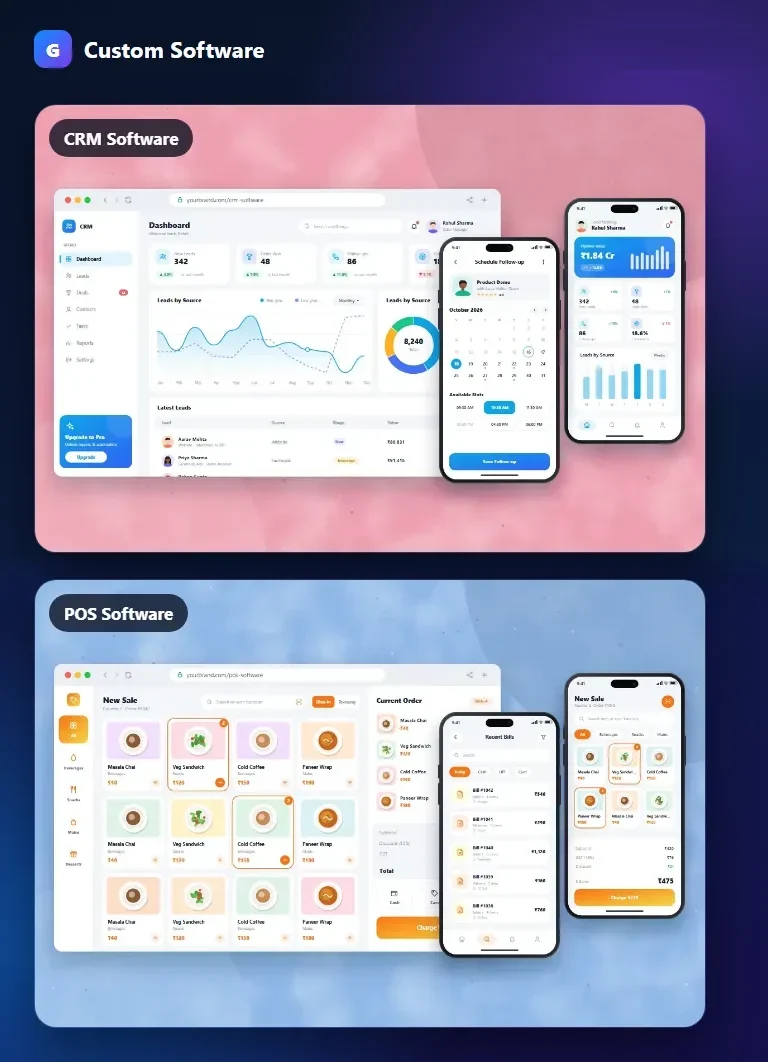
A sample of the software in our portfolio — the same standard we apply to every project in Sabroom. Open any project to see its features, workflow and pricing.
 Restaurant Online Ordering System
 Food Delivery Website
 Grocery Delivery App
 CRM Software
 Single-vendor eCommerce Website
 Food Delivery App
 CRM SaaS
 Multi-Store Management Software
 WhatsApp AI Chatbot
 AI Voice Calling Agent
 Online Form Builder
 Job Search Mobile App
 SEO Campaign Management
 AI Chatbot for Websites
 Quiz Application
 Applicant Tracking System (ATS)
 Social Media Management Platform
 Doctor Appointment Booking App
 Learning Management System (LMS)
 Job Portal Website
 Expense Management App
 Electronic Medical Records (EMR)
 Online Course Selling Platform
 Property Booking App
 Insurance CRM
 Telemedicine Platform
 Bike Taxi App
 Property Dealer CRM
 Insurance Broker Portal
 Social Networking App
The commercial reasons that come up most often in conversations with clients here.
Where this market is heading, and what we build for because of it.
India is one of the fastest-growing digital economies in the world, with UPI payments, cheap mobile data and mobile-first buyers.
Business software in Sabroom is being rebuilt around APIs first, so the same data can feed a portal, a mobile app and a reporting dashboard.
AI answer engines now sit between the search box and the click, which rewards factual, well-structured pages and penalises padded content.
Automation is moving downmarket fast: workflows that only enterprises could afford are now realistic for small teams in Sabroom.
The problems clients most often bring us — and how we deal with each one.
A recoloured theme is easy to spot and hard to extend. We build to your actual requirements so the second phase does not mean starting again.
Heavy builds waste ad spend and lose mobile users in Sabroom. Performance budgets are set at the start of the project, not audited after complaints.
If analytics and goals are not configured, nobody can tell what worked. We set up tracking before launch, not months later.
Contact forms and payment flows in Sabroom get probed constantly. Validation, rate limiting and backups are part of the baseline, not extras.
Payment, CRM and inventory links need error handling and retries. We test the failure paths, not just the happy path.
Attractive layouts that bury the enquiry path convert badly. We design around the decision, not around the trend.
Why Java Development here needs a different approach from a generic build.
The commercial character of Sabroom is what determines whether a Java Development project succeeds here. Sabroom sits inside India's wider economy, where IT & Software, Retail & Trading, Manufacturing set the commercial pace and local firms compete for the same online attention.
Buyers here are relationship-led, price-sensitive and fast-moving, with decisions often made directly by the founder or promoter. That behaviour has direct design consequences: it decides what belongs above the fold, how much proof a page needs, and where the enquiry form should sit.
The market is shaped by the fact that it is one of the fastest-growing digital economies in the world, with UPI payments, cheap mobile data and mobile-first buyers. Plenty of businesses in Sabroom still have no properly optimised presence on Google, which handles the overwhelming majority of searches in India, which leaves qualified demand unclaimed.
Our Java Development work maps to the sectors that actually drive this market.
Everything we deliver under Java Development for businesses in Sabroom — each scoped and priced individually so you only pay for what you need.
Spring Boot Development delivered for Sabroom businesses, scoped in writing and built to scale with you.
Java REST API Development delivered for Sabroom businesses, scoped in writing and built to scale with you.
Enterprise Java Integration delivered for Sabroom businesses, scoped in writing and built to scale with you.
Java Microservices delivered for Sabroom businesses, scoped in writing and built to scale with you.
Legacy Java Modernisation delivered for Sabroom businesses, scoped in writing and built to scale with you.
Java Performance Engineering delivered for Sabroom businesses, scoped in writing and built to scale with you.
An illustration of how this kind of work usually goes — not a specific client. For real projects you can open and check, see our portfolio.
IT & Software businesses in Sabroom often come to us when they have outgrown spreadsheets, and reconciling data across teams takes days of staff time every month.
We usually build a role-based platform that brings operational data together, automate the reconciliation work that was manual, and expose an API so reports can be generated on demand.
The same sequence we follow on every Java Development project in Sabroom, with a written checkpoint at each stage.
We map your goals, competitors in Sabroom and the questions your customers actually ask before buying.
Information architecture and low-fidelity flows agreed before any visual design starts.
Brand-aligned interface design with an accessible type, colour and spacing system.
Modular build with role-based access, audit logging and third-party integrations.
Functional testing plus input validation, access control and backup verification.
Deployment, analytics verification, documentation and full credential handover.
Monthly reviews, A/B tests and prioritised improvements after launch.
The stack behind Java Development projects we deliver in Sabroom — chosen for maintainability, not novelty.
Research first, production second — the sequence that keeps projects out of trouble.
We do not begin Java Development work in Sabroom from a template library. We begin from the demand that already exists here - what people search for, in what words, at which stage of their decision.
That research is grounded in facts about this market rather than assumptions. Sabroom sits inside India's wider economy, where IT & Software, Retail & Trading, Manufacturing set the commercial pace and local firms compete for the same online attention. So the priorities we set for IT & Software and Retail & Trading clients here look nothing like the priorities we would set in a different market.
On the build side, that translates into concrete decisions: how roles and permissions are modelled, which processes get automated first, what the audit trail records, and how the system behaves when an integration is unavailable. We design the data model for where your business in Sabroom expects to be in three years, not just for today's process.
Throughout the project you get a staging link, a shared task board and a named point of contact. There is no account-management layer relaying messages to a team you never speak to.
What the DPDP Act and the sector rules change about the build.
Compliance shapes Java Development work in Sabroom more than most buyers expect. The Digital Personal Data Protection Act, 2023 governs what you may collect and how long you may keep it, and those answers determine your data model.
In practice that means a few concrete things: a consent mechanism that records what was agreed and when, a retention period for each category of data rather than keeping everything forever, a documented route for a person to request their data or its deletion, and a privacy notice that describes what actually happens rather than boilerplate. It also means RBI card-tokenisation rules, which mean you cannot store raw card numbers yourself.
One honest caveat. We can build to the DPDP Act and hand you the documentation, but a compliance opinion has to come from a qualified adviser in India. We will tell you when we think you need one.
How we make sure the work we deliver actually surfaces in local search.
Java Development is only half the job. The other half is making sure the result surfaces when someone in Sabroom searches for what you do.
The market is shaped by the fact that it is one of the fastest-growing digital economies in the world, with UPI payments, cheap mobile data and mobile-first buyers. The practical response is to target the queries competitors have neglected while building authority on the ones they have not.
The work splits into three parts: technical health so pages can be indexed properly, content that answers the questions buyers in Sabroom actually type, and local signals such as profile accuracy and genuine reviews that drive map-pack visibility.
Plenty of businesses in Sabroom still have no properly optimised presence on Google, which handles the overwhelming majority of searches in India, which leaves qualified demand unclaimed. That gap does not stay open forever, which is the main argument for starting now rather than next year.
Honest ranges, and the three things that actually move them.
The question every buyer in Sabroom asks first is how long Java Development takes, and the honest answer is a range rather than a date. For a first working module, plan on 8 to 12 weeks. For a full internal platform with roles and reporting, plan on 6 to 9 months. A firm date offered before scope is agreed is a marketing number. We will give you one once we know what we are building.
What moves that timeline is rarely the engineering. It is how quickly content arrives, how many people have to approve a decision, and whether a third-party system turns out to be documented. Those three account for most of the overruns we have seen in Sabroom.
Progress is visible rather than reported: a staging link updated continuously, and a reviewable increment every two weeks. Slippage shows up early enough to do something about it.
Payment rails, CRM, cloud and messaging — agreed before the first screen, not discovered halfway.
Almost nothing we build for Sabroom stands on its own. A Java Development project earns its keep when it is wired into the systems the business already runs on - so the integration list is agreed before the first screen is designed, not discovered halfway through.
On payments, the rails that matter in India are not the ones a generic template ships with. We work with UPI, Razorpay, PayU, Cashfree, CCAvenue, Paytm and PhonePe, and pick between them on settlement time, fee structure and how much of the compliance burden the provider absorbs. We will tell you plainly where UPI costs less than PayU at your volume, and where the cheaper option costs more in reconciliation time.
Beyond payments, internal software in Sabroom lives or dies on integration: accounting (Tally, Zoho Books, QuickBooks or Xero depending on the market), identity through Google Workspace or Microsoft Entra, storage and compute on AWS or Azure, and messaging through Twilio or the WhatsApp Business API. We map every one of those before committing to a data model.
Each connection ships with a written note on what it does, what it costs, and what breaks if it stops. That document has saved more Sabroom projects than any piece of code in them.
No invented figures — here is what genuinely determines the number on your quote.
Pricing for Java Development in Sabroom varies more with complexity than with location. Rather than publish a headline figure that would be wrong for most projects, here is what genuinely drives the number on your quote.
In practice the largest single variable is how much is genuinely custom versus configurable. Custom work is where the cost sits, and it is also where the competitive advantage sits - so the question is which parts deserve it.
Pick the engagement model that fits how your business in Sabroom actually operates.
A smaller first release that earns revenue, then funded phases after it. Popular with businesses in Sabroom testing a new line.
Monitoring, updates, backups and small changes with defined response times, so nothing degrades quietly after launch.
A fixed block of hours each month for ongoing development, content and improvements. Suits businesses that ship continuously.
Best when requirements are clear. Written scope, fixed price, milestone schedule. Change requests are quoted separately so the approved number holds.
What you actually get when you work with us, stated plainly.
Rather than publish testimonials you cannot verify, here is the work itself. Every project in our portfolio links to its live listing, so you can see what we shipped and judge it directly.
Gletus Technology is a single IT partner for Sabroom — explore what else we deliver here.
Our home market, served from our office in Rohini, New Delhi:
We deliver Java Development across Sabroom and the surrounding market:
We also work with clients further afield:
Not sure whether we cover your area? See where we work across Delhi NCR — our office, the cities we serve, and how remote and on-site delivery works. Or browse every area we cover in Tripura.
The questions we hear most from businesses searching for Java Development in Sabroom.
Java Development in Sabroom — answered directly.
Gletus Technology Pvt Ltd is an established Java Development company serving Sabroom, with years of delivery experience and an in-house team covering strategy, design, development, QA and support. Rather than claiming a title, we would suggest judging any vendor in Sabroom on three things: relevant work you can actually inspect, a written scope, and whether you get direct access to the people building your project.
You do - completely. Source code, hosting, domain, analytics and any third-party accounts are transferred to your ownership at handover, with credentials and documentation. You are never locked into us to make changes.
Success measures are agreed before development starts - enquiries, qualified leads, bookings, orders or whatever maps to your commercial goal. Analytics and conversion tracking are configured before launch, so the first month's data is usable rather than retrospective guesswork.
More questions we are asked about Java Development in Sabroom:
Yes, and both are treated as requirements rather than as a later audit. We set a performance budget at kickoff and test on mid-range devices rather than only on flagship phones, because that is what most visitors in Sabroom actually browse on.
Milestone-based delivery exists precisely so this is caught early. You review and approve at each stage, and if something is not right at a checkpoint we fix it before moving on. Disagreements about scope are settled against the written scope document rather than against memory.
A conversation about goals, whatever brand assets exist, and one decision-maker who can approve at each milestone. Content can be developed alongside the build - missing content is the single most common cause of delay, so we plan for it from the start.
That is worth checking rather than taking on trust. Ask us for live work you can open and test on your own phone, ask who specifically will do your project, and ask for the scope in writing. We will answer all three directly. Any supplier that will not is telling you something useful.
Cost depends on scope rather than location. A focused launch project is priced very differently from a multi-module platform with integrations. What we do commit to in Sabroom is an itemised quote in INR (Rs.) before work starts, with change requests priced separately so the number you approve is the number you pay. Send us your requirements and you will have a written breakdown within two working days.
Yes. We deliver for clients across Delhi NCR and internationally, which is useful context rather than a distraction - patterns that work in one market are frequently worth testing in another. Your project is still scoped for Sabroom specifically.
That is the point of building custom. We design the data model and module boundaries for where you expect to be in three years, so adding users, locations or modules is configuration work rather than a rewrite.
Role-based access control, encrypted credentials, audit logging, input validation and scheduled backups are part of the baseline build. For regulated sectors we scope the specific compliance requirements during discovery rather than assuming a generic standard.
Yes - accounting, CRM, payment gateways, logistics and messaging platforms are all common. We check API availability during discovery, because an integration that looked simple in a sales meeting occasionally turns out to have no public API at all.
Usually yes, and often more so - a competitor already ranking proves the demand exists and is capturable. The market is shaped by the fact that it is one of the fastest-growing digital economies in the world, with UPI payments, cheap mobile data and mobile-first buyers. The route in is rarely a head-on fight; it is the specific queries they have neglected.
Demand tracks the local economy closely. Sabroom sits inside India's wider economy, where IT & Software, Retail & Trading, Manufacturing set the commercial pace and local firms compete for the same online attention. Those are the sectors we field the most enquiries from here.
Buyers here are relationship-led, price-sensitive and fast-moving, with decisions often made directly by the founder or promoter. That is not a guess we make at proposal stage - it comes from delivering work in this market and watching what converts.
Yes - accounting (Tally, Zoho Books, QuickBooks or Xero), identity through Google Workspace or Microsoft Entra, storage and compute on AWS or Azure, and messaging through Twilio or the WhatsApp Business API. Every connection is documented with its credentials, rate limits and failure behaviour, and the accounts are registered in your name so nothing goes dark if you change supplier.
A first working module is typically 8 to 12 weeks; a full internal platform with roles and reporting runs 6 to 9 months. What moves those dates is rarely the engineering - it is how quickly content arrives, how many people must approve a decision, and whether a third-party system turns out to be documented. We commit to a date at the end of discovery, when it means something, rather than on the first call.
We build to WCAG 2.2 AA: semantic headings, form controls with real labels, keyboard-operable navigation, a visible focus state, sufficient colour contrast, and no meaning carried by colour alone. It widens the audience you can sell to in Sabroom, it is increasingly what procurement asks about, and it overlaps almost entirely with what search engines reward anyway.
If you collect a name, an email or a payment from someone in India, the Digital Personal Data Protection Act, 2023 applies. In practice that means recorded consent rather than assumed consent, a stated retention period for each type of data, a working route for access and deletion requests, and a privacy notice that describes what actually happens. Locally it also means accounting for RBI card-tokenisation rules, which mean you cannot store raw card numbers yourself. We build and document to that standard; a formal compliance opinion should come from a qualified adviser in India.
For clients in India we work with UPI, Razorpay, PayU, Cashfree, CCAvenue, Paytm and PhonePe. The right choice depends on your average order value, refund pattern and settlement timing rather than brand familiarity - at low volume UPI is usually the practical default, and we will say plainly when a cheaper provider would cost you more in reconciliation time. Card details always go straight to the gateway, so your system stores a token rather than a card number.
Sabroom में सॉफ़्टवेयर से जुड़े वे सवाल, जो ग्राहक काम शुरू करने से पहले सबसे ज़्यादा पूछते हैं।
हाँ। भारतीय प्रोजेक्ट्स में हम UPI, Razorpay, PayU, Cashfree और कार्ड/नेट-बैंकिंग जैसे विकल्प जोड़ते हैं, और रिफंड तथा फ़ेल हुए ट्रांज़ैक्शन की स्थिति को भी सही तरीके से संभालते हैं - सिर्फ़ बटन लगाना काफ़ी नहीं होता।
हाँ। वेबसाइट हिंदी सहित अन्य भारतीय भाषाओं में या दो भाषाओं में एक साथ बनाई जा सकती है, और हर भाषा के लिए अलग URL रखा जाता है ताकि Google उसे सही भाषा में दिखा सके।
लागत पूरी तरह स्कोप पर निर्भर करती है - कितने पेज या स्क्रीन चाहिए, कौन-से फ़ीचर चाहिए, और किन बाहरी सिस्टम से जोड़ना है। हम काम शुरू करने से पहले लिखित कोटेशन देते हैं जिसमें स्कोप, टाइमलाइन और भुगतान के चरण साफ़ लिखे होते हैं, ताकि बाद में कोई छिपा हुआ चार्ज न आए। इसी पेज पर ऊपर लागत वाला सेक्शन देखें।
दोनों हम करा सकते हैं, या आपके पास पहले से हों तो उन्हीं पर काम कर लेते हैं। हमारी सलाह यही रहती है कि डोमेन और होस्टिंग आपके अपने अकाउंट में रहें और हमें सिर्फ़ ज़रूरी एक्सेस मिले।
हाँ। Gletus Technology Pvt Ltd का ऑफ़िस रोहिणी, नई दिल्ली में है और हम Sabroom के क्लाइंट्स के साथ काम करते हैं। ज़्यादातर काम ऑनलाइन मीटिंग और साझा ट्रैकर पर होता है; ज़रूरत पड़ने पर आमने-सामने बैठक भी की जा सकती है।
पूरा भुगतान होने के बाद कोड, कंटेंट और डिज़ाइन का मालिकाना हक आपका होता है। डोमेन और होस्टिंग अकाउंट भी आपके नाम पर रखे जाते हैं, ताकि आगे आप जिस भी एजेंसी के साथ काम करें, कुछ भी अटके नहीं।
समय फ़ीचर्स और कंटेंट की तैयारी पर निर्भर करता है। सबसे बड़ी देरी आमतौर पर डेवलपमेंट से नहीं, बल्कि कंटेंट, इमेज और अप्रूवल के इंतज़ार से होती है - इसलिए हम शुरू में ही यह तय कर लेते हैं कि क्या-क्या आपकी तरफ़ से चाहिए। इसी पेज पर टाइमलाइन वाला सेक्शन चरणवार ब्योरा देता है।
हाँ। भारत में ज़्यादातर ग्राहक फ़ॉर्म भरने के बजाय WhatsApp पर बात करना पसंद करते हैं, इसलिए हम WhatsApp बटन और क्लिक-टु-कॉल जोड़ते हैं, और चाहें तो फ़ॉर्म की जानकारी सीधे आपके WhatsApp या ईमेल पर भेजी जा सकती है।
Log aksar aise bhi search karte hain
The published standards our Java Development work is built against.
Related searches
Ready to move? We can begin discovery for your Java Development project in Sabroom this week.
Gletus Technology delivers Website Development, Mobile App Development, Software Development & Digital Marketing services to businesses and startups across Delhi, Noida, Greater Noida, Gurugram, Faridabad & Ghaziabad. Pick your area below — we are just a call away.
From our blog
Practical guides from the Gletus team on what projects cost, which technology fits, and how to grow your business online.
What an Android or iOS app actually costs to build in India, why quotes differ so widely, and the questions that make a quote comparable.

PHP, Node, Python, React, Flutter - how to decide what your project should be built in, without relying on whichever the agency happens to prefer.

The steps that actually move a business into the local map results, in the order worth doing them, with the common Indian mistakes called out.
Gletus leverages the latest web and mobile technologies to ensure every product we deliver is modern, high-performing, and aligned with industry standards.