



Cost guides
Mobile App Development Cost in India: What Drives the Price
What an Android or iOS app actually costs to build in India, why quotes differ so widely, and the questions that make a quote comparable.

Looking for Billing Software Development in Otsu that actually moves the numbers? Gletus Technology delivers GST-ready invoicing and accounts software, backed by years of hands-on delivery and support that does not disappear after launch.
Gletus Technology Pvt Ltd is a Billing Software Development company serving Otsu, Japan. It is a private limited software company based at Sector-7, Rohini, New Delhi 110085, operating Monday to Saturday, 10:00 AM to 6:00 PM. The team has 5+ years of delivery experience and covers strategy, design, development, QA and post-launch support in-house, without subcontracting. Work in this area typically covers GST Billing Software, Invoice and Quotation Module, Payment Reminder Automation, Recurring Billing. Typical clients in Otsu include Manufacturing, Automotive, Robotics businesses. Buyers here are detail-perfect and consensus-based, with long evaluation cycles and near-zero tolerance for defects. Engagements start with a written scope and itemised pricing in JPY, and code, hosting and analytics accounts transfer to client ownership at handover. Delivery is remote, with work scheduled around the client's timezone. Contact: +91 9131739457 / info@gletus.com.
Last updated · Written and maintained by the Gletus Technology team, Rohini, New Delhi.
If you are shortlisting a Billing Software Development company in Otsu, the useful question is not who has the longest feature list - it is who has worked with businesses like yours. Otsu is a business centre within Japan, and we build for that reality rather than a generic brief.
Gletus Technology brings 5+ years of delivery experience to every Billing Software Development engagement in Otsu. We are deliberately a build-and-support partner rather than a launch-and-vanish agency, and our maintenance retainers reflect that.
For web projects that means Core Web Vitals treated as a requirement, semantic markup that search engines can parse, and a CMS your own team can operate without calling us every week.
Whether you are launching something new in Otsu or replacing a platform that has stopped earning its keep, the goal is the same: GST-ready invoicing and accounts software that produce measurable commercial results.
Our Portfolio
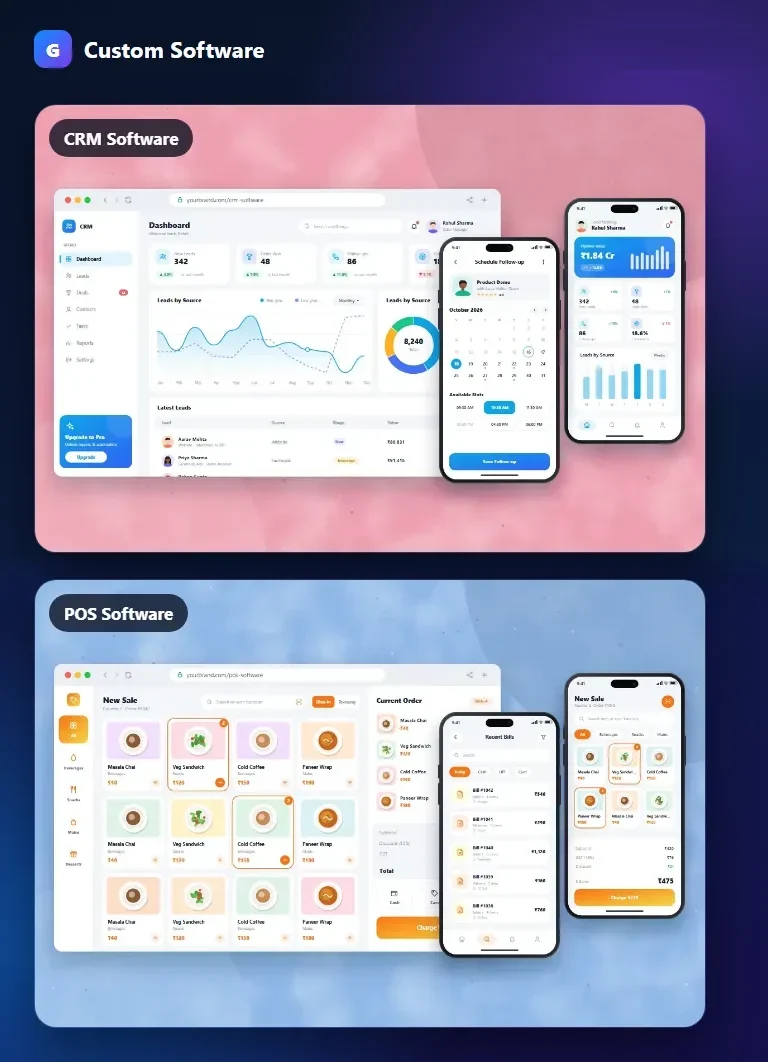
A sample of the websites and platforms in our portfolio — the same standard we apply to every project in Otsu. Open any project to see its features, workflow and pricing.
 Food Delivery Website
 Grocery Delivery App
 Restaurant Online Ordering System
 Single-vendor eCommerce Website
 Food Delivery App
 CRM Software
 Multi-Store Management Software
 WhatsApp AI Chatbot
 CRM SaaS
 Online Form Builder
 Job Search Mobile App
 AI Voice Calling Agent
 AI Chatbot for Websites
 Quiz Application
 SEO Campaign Management
 Social Media Management Platform
 Doctor Appointment Booking App
 Applicant Tracking System (ATS)
 Job Portal Website
 Expense Management App
 Learning Management System (LMS)
 Online Course Selling Platform
 Property Booking App
 Electronic Medical Records (EMR)
 Telemedicine Platform
 Bike Taxi App
 Insurance CRM
 Insurance Broker Portal
 Social Networking App
 Property Dealer CRM
The problems clients most often bring us — and how we deal with each one.
Plenty of businesses in Otsu have a site nobody can update because the original developer stopped answering. We hand over full access, credentials and documentation as a matter of course.
Contact forms and payment flows in Otsu get probed constantly. Validation, rate limiting and backups are part of the baseline, not extras.
Attractive layouts that bury the enquiry path convert badly. We design around the decision, not around the trend.
A recoloured theme is easy to spot and hard to extend. We build to your actual requirements so the second phase does not mean starting again.
Scope creep is usually a symptom of vague discovery. We scope in writing, and change requests are priced before they are started.
Retrofitting SEO onto a finished build is expensive. Structure, schema and speed are handled during development.
The commercial reasons that come up most often in conversations with clients here.
Why Billing Software Development here needs a different approach from a generic build.
The commercial character of Otsu is what determines whether a Billing Software Development project succeeds here. Otsu sits inside Japan's wider economy, where Manufacturing, Automotive, Robotics set the commercial pace and local firms compete for the same online attention.
Buyers here are detail-perfect and consensus-based, with long evaluation cycles and near-zero tolerance for defects. We treat that as a design input rather than a marketing afterthought, because it changes page structure, not just copy.
The market is shaped by the fact that it is a market where information density, precise Japanese typography and flawless QA matter more than minimalist design trends. Plenty of businesses in Otsu still have no properly optimised presence on Google and Yahoo! Japan, both Google-powered, which leaves qualified demand unclaimed.
Practical detail matters at this distance: pricing is presented in JPY (¥), our delivery overlaps with JST (UTC+9), and communication runs in Japanese & English. Search visibility work targets Google and Yahoo! Japan, both Google-powered.
Our Billing Software Development work maps to the sectors that actually drive this market.
Where this market is heading, and what we build for because of it.
Japan is a market where information density, precise Japanese typography and flawless QA matter more than minimalist design trends.
Web projects in Otsu are moving toward component-driven front ends and headless content, which makes redesigns incremental instead of catastrophic.
Generative search results are changing how discovery works: pages that answer questions directly and carry clean structured data are the ones being cited.
Privacy expectations keep tightening, and consent-aware analytics is becoming the default rather than a compliance exercise.
Everything we deliver under Billing Software Development for businesses in Otsu — each scoped and priced individually so you only pay for what you need.
GST Billing Software delivered for Otsu businesses, scoped in writing and built to scale with you.
Invoice and Quotation Module delivered for Otsu businesses, scoped in writing and built to scale with you.
Payment Reminder Automation delivered for Otsu businesses, scoped in writing and built to scale with you.
Recurring Billing delivered for Otsu businesses, scoped in writing and built to scale with you.
Tally Export Integration delivered for Otsu businesses, scoped in writing and built to scale with you.
Multi Company Billing delivered for Otsu businesses, scoped in writing and built to scale with you.
An illustration of how this kind of work usually goes — not a specific client. For real projects you can open and check, see our portfolio.
Retail businesses in Otsu often come to us when they have outgrown spreadsheets, and reconciling data across teams takes days of staff time every month.
We usually set a performance budget, restructure the site around how buyers actually search, add schema markup and move content editing into a CMS your own team can run.
The same sequence we follow on every Billing Software Development project in Otsu, with a written checkpoint at each stage.
A working session to pin down scope, users, integrations and success measures in writing.
User journeys, screen inventory and edge cases documented so nothing is discovered late.
Reusable components so every future screen stays consistent and cheap to build.
Semantic, standards-based build with performance budgets enforced throughout.
Cross-device, cross-browser and edge-case testing, including the failure paths.
Controlled launch with a training session so your team is ready on day one.
Ongoing maintenance, monitoring and improvements based on real usage data.
The stack behind Billing Software Development projects we deliver in Otsu — chosen for maintainability, not novelty.
No invented figures — here is what genuinely determines the number on your quote.
We quote Billing Software Development in Otsu in JPY (¥), itemised by deliverable. Before that quote exists, these are the factors we work through with you.
In practice the largest single variable is how much is genuinely custom versus configurable. Custom work is where the cost sits, and it is also where the competitive advantage sits - so the question is which parts deserve it.
How we make sure the work we deliver actually surfaces in local search.
Being findable in Otsu is a separate discipline from having a good Billing Software Development project, and the two are often confused. A well-built site that nobody finds is an expensive brochure.
The market is shaped by the fact that it is a market where information density, precise Japanese typography and flawless QA matter more than minimalist design trends. We treat that as the starting position rather than a reason to avoid the market.
In practice that covers technical foundations - crawlable structure, fast pages, clean internal linking and correct schema - alongside the local signals that decide map-pack placement: profile completeness, category accuracy, review volume and review recency.
Plenty of businesses in Otsu still have no properly optimised presence on Google and Yahoo! Japan, both Google-powered, which leaves qualified demand unclaimed. That gap does not stay open forever, which is the main argument for starting now rather than next year.
Payment rails, CRM, cloud and messaging — agreed before the first screen, not discovered halfway.
The integration surface is where Billing Software Development projects in Otsu usually overrun. We settle it up front: what has to talk to what, which side owns the data, and what happens when one of them is unavailable.
On payments, the rails that matter in Japan are not the ones a generic template ships with. We work with Stripe, PayPay, Rakuten Pay and convenience-store (konbini) payment, and pick between them on settlement time, fee structure and how much of the compliance burden the provider absorbs. Whether Rakuten Pay or convenience-store (konbini) payment is right for you depends on your average order value and your refund pattern, not on which is better known.
Beyond payments, a site in Otsu usually has to reach a CRM, an email platform and an analytics stack. We integrate Zoho, Salesforce, HubSpot, Freshworks and Pipedrive on the CRM side; Mailchimp, SendGrid or Brevo for email; Google Analytics 4 and Google Tag Manager for measurement; and Google Maps Platform where location matters to the customer.
We keep integration credentials in your accounts rather than ours. If you replace us, nothing has to be re-registered and no service goes dark during the handover.
What APPI and the sector rules change about the build.
Anything that collects a name, an email or a payment in Japan sits under the Act on the Protection of Personal Information. That is not a legal-department problem to solve after launch - it changes what the forms ask for, how consent is recorded and how long data is kept, so it belongs in the build.
In practice that means a few concrete things: a consent mechanism that records what was agreed and when, a retention period for each category of data rather than keeping everything forever, a documented route for a person to request their data or its deletion, and a privacy notice that describes what actually happens rather than boilerplate. On top of that sits Japanese typography and vertical-rhythm conventions that Latin-first templates get wrong.
Sector rules stack on top. If you take card payments, PCI DSS applies regardless of jurisdiction, which is the main reason we route cards through a provider rather than touching them ourselves. If you handle health information for Manufacturing or Automotive clients, expect stricter retention and access-logging requirements than the baseline.
One honest caveat. We can build to APPI and hand you the documentation, but a compliance opinion has to come from a qualified adviser in Japan. We will tell you when we think you need one.
Honest ranges, and the three things that actually move them.
The question every buyer in Otsu asks first is how long Billing Software Development takes, and the honest answer is a range rather than a date. For a well-built brochure site, plan on 4 to 6 weeks. For a transactional or catalogue site, plan on 10 to 16 weeks. Anyone quoting you a firm delivery date before seeing your requirements is quoting a sales figure, not a schedule.
Schedules slip for predictable reasons: content that has not been written, approval chains nobody mapped, and an integration whose documentation turns out to be a phone number. We plan around all three rather than hoping.
Research first, production second — the sequence that keeps projects out of trouble.
Every Billing Software Development engagement in Otsu starts the same way: we look at who is already ranking, what they are saying, and where their pages fall short. That audit is usually more useful than a creative brief, because it shows exactly which gaps are winnable.
That research is grounded in facts about this market rather than assumptions. Otsu sits inside Japan's wider economy, where Manufacturing, Automotive, Robotics set the commercial pace and local firms compete for the same online attention. Which is why the first version we present for Otsu is shaped around Manufacturing and Automotive buying behaviour specifically.
On the build side, that translates into concrete decisions: what belongs above the fold, how deep the URL structure goes, which pages carry schema markup, and what the page-weight ceiling is on a mid-range Android device. We test on the hardware your customers in Otsu actually use rather than on a developer's flagship phone.
You review work in progress rather than a finished reveal. That catches misunderstandings in week two instead of week ten, which is the single biggest cost saver on any project.
Pick the engagement model that fits how your business in Otsu actually operates.
A short engagement that reviews what you have, quantifies the problems and prioritises fixes. Useful before committing to a rebuild.
Developers and designers working only on your roadmap, managed by us, reporting to you. For sustained multi-month programmes.
A smaller first release that earns revenue, then funded phases after it. Popular with businesses in Otsu testing a new line.
Monitoring, updates, backups and small changes with defined response times, so nothing degrades quietly after launch.
What you actually get when you work with us, stated plainly.
Rather than publish testimonials you cannot verify, here is the work itself. Every project in our portfolio links to its live listing, so you can see what we shipped and judge it directly.
Gletus Technology is a single IT partner for Otsu — explore what else we deliver here.
Our home market, served from our office in Rohini, New Delhi:
We deliver Billing Software Development across Japan and the surrounding market:
We also work with clients further afield:
Not sure whether we cover your area? See where we work across Delhi NCR — our office, the cities we serve, and how remote and on-site delivery works. Or browse every area we cover in Japan.
The questions we hear most from businesses searching for Billing Software Development in Otsu.
Billing Software Development in Otsu — answered directly.
Gletus Technology Pvt Ltd is an established Billing Software Development company serving Otsu, with years of delivery experience and an in-house team covering strategy, design, development, QA and support. Rather than claiming a title, we would suggest judging any vendor in Otsu on three things: relevant work you can actually inspect, a written scope, and whether you get direct access to the people building your project.
Success measures are agreed before development starts - enquiries, qualified leads, bookings, orders or whatever maps to your commercial goal. Analytics and conversion tracking are configured before launch, so the first month's data is usable rather than retrospective guesswork.
Yes. The first conversation is free and has no obligation - we will tell you what we think the project needs, roughly what it costs, and whether we are the right fit. If we are not, we will say so.
More questions we are asked about Billing Software Development in Otsu:
Yes, and both are treated as requirements rather than as a later audit. We set a performance budget at kickoff and test on mid-range devices rather than only on flagship phones, because that is what most visitors in Otsu actually browse on.
We start with an audit rather than a sales pitch - performance, structure, security, search visibility and conversion. Often the foundation is sound and targeted fixes cost a fraction of a rebuild. Where a rebuild genuinely is cheaper over two years, we will show you that arithmetic.
Yes. We work with clients in Otsu and across Japan remotely, with overlapping hours against JST (UTC+9) and communication in Japanese & English. Delivery runs on shared project boards, scheduled calls and staging links, so distance does not reduce visibility.
Yes. We deliver for clients across Japan and internationally, which is useful context rather than a distraction - patterns that work in one market are frequently worth testing in another. Your project is still scoped for Otsu specifically.
You do - completely. Source code, hosting, domain, analytics and any third-party accounts are transferred to your ownership at handover, with credentials and documentation. You are never locked into us to make changes.
Often, yes, and it is usually the cheaper route. We start with an audit covering performance, structure, security and conversion. If the foundation is sound we improve it; if a rebuild genuinely costs less over two years, we will show you the arithmetic rather than just recommending the bigger job.
Structure, semantic markup, schema, internal linking, sitemaps and speed are handled during development rather than retrofitted. That is the groundwork - ongoing ranking work is a separate, continuing effort we can also handle.
Performance is treated as a requirement, not a post-launch audit. We set a page-weight and Core Web Vitals budget at the start, test on mid-range devices rather than flagship phones, and hold the build to it before go-live.
Yes. We hand over a CMS your team can genuinely operate, plus a short training session and written documentation. If your team cannot make a routine text change without calling a developer, the build has failed.
Yes - a significant share of our work is with early-stage and small businesses. Plenty of businesses in Otsu still have no properly optimised presence on Google and Yahoo! Japan, both Google-powered, which leaves qualified demand unclaimed. We scope a first phase that fits the budget available and expands once it is earning.
Japan is a market where information density, precise Japanese typography and flawless QA matter more than minimalist design trends. We factor that into the build rather than treating it as a future upgrade.
Three practical things: an in-house team rather than a subcontractor chain, written scope and pricing before work begins, and full handover of code and accounts at launch. The market is shaped by the fact that it is a market where information density, precise Japanese typography and flawless QA matter more than minimalist design trends.
If you collect a name, an email or a payment from someone in Japan, the Act on the Protection of Personal Information applies. In practice that means recorded consent rather than assumed consent, a stated retention period for each type of data, a working route for access and deletion requests, and a privacy notice that describes what actually happens. Locally it also means accounting for Japanese typography and vertical-rhythm conventions that Latin-first templates get wrong. We build and document to that standard; a formal compliance opinion should come from a qualified adviser in Japan.
We build to WCAG 2.2 AA: semantic headings, form controls with real labels, keyboard-operable navigation, a visible focus state, sufficient colour contrast, and no meaning carried by colour alone. It widens the audience you can sell to in Otsu, it is increasingly what procurement asks about, and it overlaps almost entirely with what search engines reward anyway.
A well-built brochure site is typically 4 to 6 weeks; a transactional or catalogue site runs 10 to 16 weeks. What moves those dates is rarely the engineering - it is how quickly content arrives, how many people must approve a decision, and whether a third-party system turns out to be documented. We commit to a date at the end of discovery, when it means something, rather than on the first call.
You do, entirely - source code, database, design files, and every account we register on your behalf. Gateway, analytics and hosting accounts go in your name with you as owner and us added as a user, so if you stop working with us nothing needs re-registering and no service is interrupted. There is no fee to leave and no licence retained.
For clients in Japan we work with Stripe, PayPay, Rakuten Pay and convenience-store (konbini) payment. The right choice depends on your average order value, refund pattern and settlement timing rather than brand familiarity - at low volume Stripe is usually the practical default, and we will say plainly when a cheaper provider would cost you more in reconciliation time. Card details always go straight to the gateway, so your system stores a token rather than a card number.
The published standards our Billing Software Development work is built against.
Related searches
Share your brief and we will come back with scope, cost and timeline for Billing Software Development in Otsu.
Gletus Technology delivers Website Development, Mobile App Development, Software Development & Digital Marketing services to businesses and startups across Delhi, Noida, Greater Noida, Gurugram, Faridabad & Ghaziabad. Pick your area below — we are just a call away.
From our blog
Practical guides from the Gletus team on what projects cost, which technology fits, and how to grow your business online.
What an Android or iOS app actually costs to build in India, why quotes differ so widely, and the questions that make a quote comparable.

PHP, Node, Python, React, Flutter - how to decide what your project should be built in, without relying on whichever the agency happens to prefer.

The steps that actually move a business into the local map results, in the order worth doing them, with the common Indian mistakes called out.
Gletus leverages the latest web and mobile technologies to ensure every product we deliver is modern, high-performing, and aligned with industry standards.