


Cost guides
Mobile App Development Cost in India: What Drives the Price
What an Android or iOS app actually costs to build in India, why quotes differ so widely, and the questions that make a quote comparable.

We build REST and GraphQL APIs, documentation and versioning for businesses across Makkah. As an API Development company that has shipped hundreds of projects across Saudi Arabia, Gletus Technology pairs practical strategy with clean engineering.
Gletus Technology Pvt Ltd is an API Development company serving Makkah, Saudi Arabia. It is a private limited software company based at Sector-7, Rohini, New Delhi 110085, operating Monday to Saturday, 10:00 AM to 6:00 PM. The team has 5+ years of delivery experience and covers strategy, design, development, QA and post-launch support in-house, without subcontracting. Work in this area typically covers REST API Development, GraphQL API Development, Third-Party API Integration, API Documentation and Versioning. Typical clients in Makkah include Energy, Construction & Infrastructure, Retail businesses. Buyers here are formal and hierarchy-aware, with Vision 2030 driving large-scale digital transformation budgets. Engagements start with a written scope and itemised pricing in SAR, and code, hosting and analytics accounts transfer to client ownership at handover. Delivery is remote, with work scheduled around the client's timezone. Contact: +91 9131739457 / info@gletus.com.
Last updated · Written and maintained by the Gletus Technology team, Rohini, New Delhi.
There is no shortage of vendors offering API Development in Makkah. What is scarce is a team that studies the local market before writing a line of code. Makkah is a business centre within Saudi Arabia, and that context changes the entire approach.
With 5+ years behind us and an in-house team covering design, development, QA and support, Gletus Technology builds REST and GraphQL APIs, documentation and versioning without handing your project through a chain of subcontractors.
For software projects that means clear data models, role-based access, audit trails and integrations that survive contact with your existing systems.
Whether you are launching something new in Makkah or replacing a platform that has stopped earning its keep, the goal is the same: REST and GraphQL APIs, documentation and versioning that produce measurable commercial results.
Whether you searched for API Development, application programming interface development, or API integration, you are looking for the same thing. We use the short form on this page for readability, but the service is identical.
Our Portfolio
A sample of the software in our portfolio — the same standard we apply to every project in Makkah. Open any project to see its features, workflow and pricing.
 Restaurant Online Ordering System
 Food Delivery Website
 Grocery Delivery App
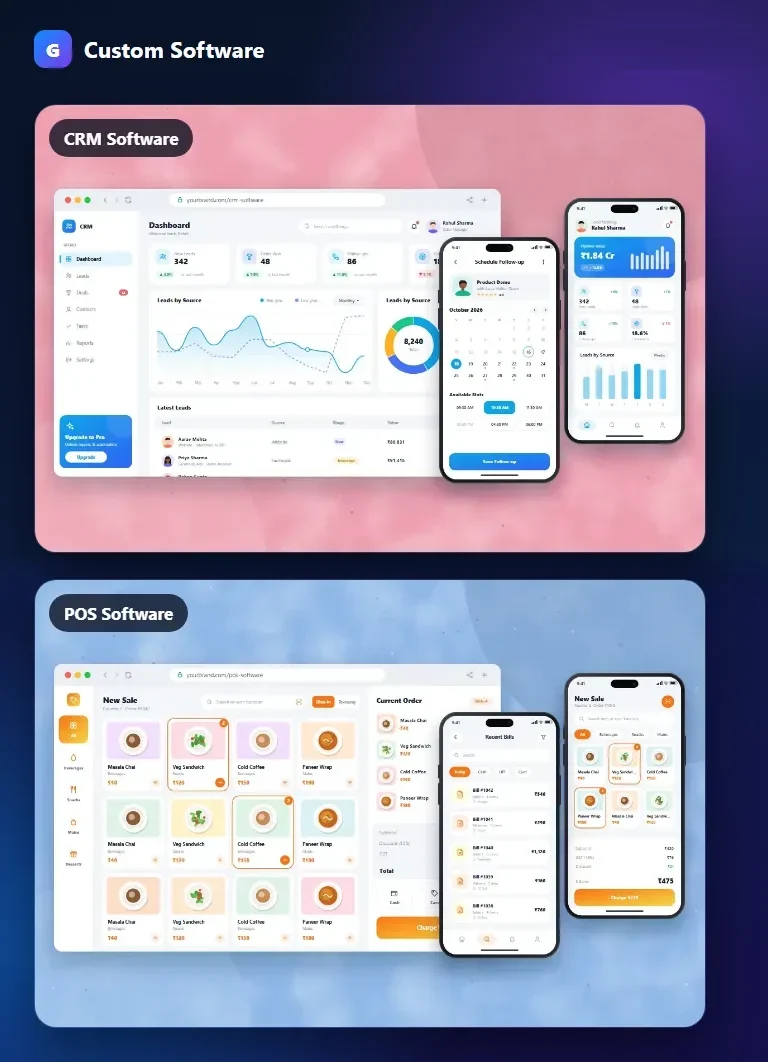
 CRM Software
 Single-vendor eCommerce Website
 Food Delivery App
 CRM SaaS
 Multi-Store Management Software
 WhatsApp AI Chatbot
 AI Voice Calling Agent
 Online Form Builder
 Job Search Mobile App
 SEO Campaign Management
 AI Chatbot for Websites
 Quiz Application
 Applicant Tracking System (ATS)
 Social Media Management Platform
 Doctor Appointment Booking App
 Learning Management System (LMS)
 Job Portal Website
 Expense Management App
 Electronic Medical Records (EMR)
 Online Course Selling Platform
 Property Booking App
 Insurance CRM
 Telemedicine Platform
 Bike Taxi App
 Property Dealer CRM
 Insurance Broker Portal
 Social Networking App
The commercial reasons that come up most often in conversations with clients here.
The problems clients most often bring us — and how we deal with each one.
Scope creep is usually a symptom of vague discovery. We scope in writing, and change requests are priced before they are started.
A recoloured theme is easy to spot and hard to extend. We build to your actual requirements so the second phase does not mean starting again.
Plenty of businesses in Makkah have a site nobody can update because the original developer stopped answering. We hand over full access, credentials and documentation as a matter of course.
Locked-down builds force every small edit through a developer. We hand over a CMS your team can genuinely use.
Attractive layouts that bury the enquiry path convert badly. We design around the decision, not around the trend.
Heavy builds waste ad spend and lose mobile users in Makkah. Performance budgets are set at the start of the project, not audited after complaints.
Our API Development work maps to the sectors that actually drive this market.
Where this market is heading, and what we build for because of it.
Saudi Arabia is a rapidly digitising market where Arabic-first, RTL-ready platforms and local hosting are frequently mandatory.
Business software in Makkah is being rebuilt around APIs first, so the same data can feed a portal, a mobile app and a reporting dashboard.
Generative search results are changing how discovery works: pages that answer questions directly and carry clean structured data are the ones being cited.
Automation is moving downmarket fast: workflows that only enterprises could afford are now realistic for small teams in Makkah.
Why API Development here needs a different approach from a generic build.
The commercial character of Makkah is what determines whether an API Development project succeeds here. Makkah sits inside Saudi Arabia's wider economy, where Energy, Construction & Infrastructure, Retail set the commercial pace and local firms compete for the same online attention.
Buyers here are formal and hierarchy-aware, with Vision 2030 driving large-scale digital transformation budgets. That behaviour has direct design consequences: it decides what belongs above the fold, how much proof a page needs, and where the enquiry form should sit.
The market is shaped by the fact that it is a rapidly digitising market where Arabic-first, RTL-ready platforms and local hosting are frequently mandatory. Plenty of businesses in Makkah still have no properly optimised presence on Google, with Arabic-language SEO a decisive advantage, which leaves qualified demand unclaimed.
Practical detail matters at this distance: pricing is presented in SAR (SAR), our delivery overlaps with AST (UTC+3), and communication runs in Arabic & English. Search visibility work targets Google, with Arabic-language SEO a decisive advantage.
Everything we deliver under API Development for businesses in Makkah — each scoped and priced individually so you only pay for what you need.
REST API Development delivered for Makkah businesses, scoped in writing and built to scale with you.
GraphQL API Development delivered for Makkah businesses, scoped in writing and built to scale with you.
Third-Party API Integration delivered for Makkah businesses, scoped in writing and built to scale with you.
API Documentation and Versioning delivered for Makkah businesses, scoped in writing and built to scale with you.
Webhook Infrastructure delivered for Makkah businesses, scoped in writing and built to scale with you.
API Security and Rate Limiting delivered for Makkah businesses, scoped in writing and built to scale with you.
An illustration of how this kind of work usually goes — not a specific client. For real projects you can open and check, see our portfolio.
Government & Public Sector businesses in Makkah often come to us when they have outgrown spreadsheets, and reconciling data across teams takes days of staff time every month.
We usually build a role-based platform that brings operational data together, automate the reconciliation work that was manual, and expose an API so reports can be generated on demand.
The same sequence we follow on every API Development project in Makkah, with a written checkpoint at each stage.
We map your goals, competitors in Makkah and the questions your customers actually ask before buying.
Information architecture and low-fidelity flows agreed before any visual design starts.
Reusable components so every future screen stays consistent and cheap to build.
Modular build with role-based access, audit logging and third-party integrations.
Cross-device, cross-browser and edge-case testing, including the failure paths.
Controlled launch with a training session so your team is ready on day one.
Ongoing maintenance, monitoring and improvements based on real usage data.
The stack behind API Development projects we deliver in Makkah — chosen for maintainability, not novelty.
Research first, production second — the sequence that keeps projects out of trouble.
The first week of any API Development project in Makkah goes into research rather than production. We map competitor positioning, the questions buyers ask before they enquire, and the specific objections that stall deals in this market.
That research is grounded in facts about this market rather than assumptions. Makkah sits inside Saudi Arabia's wider economy, where Energy, Construction & Infrastructure, Retail set the commercial pace and local firms compete for the same online attention. That mix determines what proof a page needs to carry before an Energy or Construction & Infrastructure buyer will act on it.
On the build side, that translates into concrete decisions: how roles and permissions are modelled, which processes get automated first, what the audit trail records, and how the system behaves when an integration is unavailable. We design the data model for where your business in Makkah expects to be in three years, not just for today's process.
You review work in progress rather than a finished reveal. That catches misunderstandings in week two instead of week ten, which is the single biggest cost saver on any project.
How we make sure the work we deliver actually surfaces in local search.
Whatever we build for you, it still has to be found by people in Makkah who do not yet know your name. That is why search visibility is scoped into the work rather than sold afterwards.
The market is shaped by the fact that it is a rapidly digitising market where Arabic-first, RTL-ready platforms and local hosting are frequently mandatory. We treat that as the starting position rather than a reason to avoid the market.
The work splits into three parts: technical health so pages can be indexed properly, content that answers the questions buyers in Makkah actually type, and local signals such as profile accuracy and genuine reviews that drive map-pack visibility.
Plenty of businesses in Makkah still have no properly optimised presence on Google, with Arabic-language SEO a decisive advantage, which leaves qualified demand unclaimed. That gap does not stay open forever, which is the main argument for starting now rather than next year.
What the Saudi PDPL and the sector rules change about the build.
Compliance shapes API Development work in Makkah more than most buyers expect. The Personal Data Protection Law administered by SDAIA governs what you may collect and how long you may keep it, and those answers determine your data model.
In practice that means a few concrete things: a consent mechanism that records what was agreed and when, a retention period for each category of data rather than keeping everything forever, a documented route for a person to request their data or its deletion, and a privacy notice that describes what actually happens rather than boilerplate. It also means data-residency expectations and full Arabic and RTL layout support.
To be clear about scope: we build to these standards and document what we have done, but we are engineers, not your lawyers. Anything with real regulatory exposure should be reviewed by someone qualified in Saudi Arabia before you go live.
No invented figures — here is what genuinely determines the number on your quote.
The honest answer to what API Development costs in Makkah is that it depends on scope, and any firm quoting a fixed number before understanding your requirements is guessing. What we can do is be transparent about what actually moves the price.
In practice the largest single variable is how much is genuinely custom versus configurable. Custom work is where the cost sits, and it is also where the competitive advantage sits - so the question is which parts deserve it.
We also scope in phases where budget is tight. A focused first release that earns revenue is almost always better than a complete build delayed by six months, and businesses in Makkah rarely regret starting smaller.
Honest ranges, and the three things that actually move them.
The question every buyer in Makkah asks first is how long API Development takes, and the honest answer is a range rather than a date. For a first working module, plan on 8 to 12 weeks. For a full internal platform with roles and reporting, plan on 6 to 9 months. A firm date offered before scope is agreed is a marketing number. We will give you one once we know what we are building.
What moves that timeline is rarely the engineering. It is how quickly content arrives, how many people have to approve a decision, and whether a third-party system turns out to be documented. Those three account for most of the overruns we have seen in Makkah.
We work to fortnightly milestones with something reviewable at each one. That means you know in week four whether the schedule is holding, instead of finding out in week twelve.
Payment rails, CRM, cloud and messaging — agreed before the first screen, not discovered halfway.
The integration surface is where API Development projects in Makkah usually overrun. We settle it up front: what has to talk to what, which side owns the data, and what happens when one of them is unavailable.
On payments, the rails that matter in Saudi Arabia are not the ones a generic template ships with. We work with mada, HyperPay, PayTabs and Tap Payments, and pick between them on settlement time, fee structure and how much of the compliance burden the provider absorbs. For most Energy businesses in Makkah that comes down to mada or HyperPay, and the difference is worth an hour of discussion before it is worth a line of code.
Beyond payments, internal software in Makkah lives or dies on integration: accounting (Tally, Zoho Books, QuickBooks or Xero depending on the market), identity through Google Workspace or Microsoft Entra, storage and compute on AWS or Azure, and messaging through Twilio or the WhatsApp Business API. We map every one of those before committing to a data model.
Each connection ships with a written note on what it does, what it costs, and what breaks if it stops. That document has saved more Makkah projects than any piece of code in them.
Pick the engagement model that fits how your business in Makkah actually operates.
Developers and designers working only on your roadmap, managed by us, reporting to you. For sustained multi-month programmes.
Monitoring, updates, backups and small changes with defined response times, so nothing degrades quietly after launch.
A smaller first release that earns revenue, then funded phases after it. Popular with businesses in Makkah testing a new line.
A short engagement that reviews what you have, quantifies the problems and prioritises fixes. Useful before committing to a rebuild.
What you actually get when you work with us, stated plainly.
Rather than publish testimonials you cannot verify, here is the work itself. Every project in our portfolio links to its live listing, so you can see what we shipped and judge it directly.
Gletus Technology is a single IT partner for Makkah — explore what else we deliver here.
Our home market, served from our office in Rohini, New Delhi:
We deliver API Development across Makkah and the surrounding market:
We also work with clients further afield:
Not sure whether we cover your area? See where we work across Delhi NCR — our office, the cities we serve, and how remote and on-site delivery works. Or browse every area we cover in Makkah Province.
The questions we hear most from businesses searching for API Development in Makkah.
API Development in Makkah — answered directly.
Gletus Technology Pvt Ltd is an established API Development company serving Makkah, with years of delivery experience and an in-house team covering strategy, design, development, QA and support. Rather than claiming a title, we would suggest judging any vendor in Makkah on three things: relevant work you can actually inspect, a written scope, and whether you get direct access to the people building your project.
A tightly scoped project typically runs four to eight weeks; larger builds with custom integrations run three to five months. The variable that moves timelines most is not development speed - it is how quickly content, approvals and third-party access come back from your side. We publish a milestone schedule at kickoff so both sides can see slippage early.
Yes, and we will send one before the first detailed conversation if you prefer. Client work is confidential by default; the case studies on this page are anonymised for exactly that reason.
More questions we are asked about API Development in Makkah:
Call +91 9131739457, email info@gletus.com, message us on WhatsApp, or use the enquiry form on our contact page. Office hours are Monday to Saturday, 10:00 to 18:00 IST.
Yes. Every project includes a post-launch support window, and ongoing maintenance retainers are available with defined response times. Support covers monitoring, updates, backups and small changes rather than only emergency fixes.
Milestone-based delivery exists precisely so this is caught early. You review and approve at each stage, and if something is not right at a checkpoint we fix it before moving on. Disagreements about scope are settled against the written scope document rather than against memory.
Yes. We regularly take a defined workstream alongside an internal team - a module, a redesign or the search and performance work. Boundaries and code review conventions are agreed up front so nobody is working over the top of anyone else.
We have delivered projects for Energy, Construction & Infrastructure and Retail businesses among others, which reflects the commercial mix here. Makkah sits inside Saudi Arabia's wider economy, where Energy, Construction & Infrastructure, Retail set the commercial pace and local firms compete for the same online attention.
You do - completely. Source code, hosting, domain, analytics and any third-party accounts are transferred to your ownership at handover, with credentials and documentation. You are never locked into us to make changes.
That is the point of building custom. We design the data model and module boundaries for where you expect to be in three years, so adding users, locations or modules is configuration work rather than a rewrite.
Yes - accounting, CRM, payment gateways, logistics and messaging platforms are all common. We check API availability during discovery, because an integration that looked simple in a sales meeting occasionally turns out to have no public API at all.
Role-based access control, encrypted credentials, audit logging, input validation and scheduled backups are part of the baseline build. For regulated sectors we scope the specific compliance requirements during discovery rather than assuming a generic standard.
Saudi Arabia is a rapidly digitising market where Arabic-first, RTL-ready platforms and local hosting are frequently mandatory. We factor that into the build rather than treating it as a future upgrade.
Demand tracks the local economy closely. Makkah sits inside Saudi Arabia's wider economy, where Energy, Construction & Infrastructure, Retail set the commercial pace and local firms compete for the same online attention. Those are the sectors we field the most enquiries from here.
Yes - a significant share of our work is with early-stage and small businesses. Plenty of businesses in Makkah still have no properly optimised presence on Google, with Arabic-language SEO a decisive advantage, which leaves qualified demand unclaimed. We scope a first phase that fits the budget available and expands once it is earning.
We build to WCAG 2.2 AA: semantic headings, form controls with real labels, keyboard-operable navigation, a visible focus state, sufficient colour contrast, and no meaning carried by colour alone. It widens the audience you can sell to in Makkah, it is increasingly what procurement asks about, and it overlaps almost entirely with what search engines reward anyway.
Yes - accounting (Tally, Zoho Books, QuickBooks or Xero), identity through Google Workspace or Microsoft Entra, storage and compute on AWS or Azure, and messaging through Twilio or the WhatsApp Business API. Every connection is documented with its credentials, rate limits and failure behaviour, and the accounts are registered in your name so nothing goes dark if you change supplier.
If you collect a name, an email or a payment from someone in Saudi Arabia, the Personal Data Protection Law administered by SDAIA applies. In practice that means recorded consent rather than assumed consent, a stated retention period for each type of data, a working route for access and deletion requests, and a privacy notice that describes what actually happens. Locally it also means accounting for data-residency expectations and full Arabic and RTL layout support. We build and document to that standard; a formal compliance opinion should come from a qualified adviser in Saudi Arabia.
A first working module is typically 8 to 12 weeks; a full internal platform with roles and reporting runs 6 to 9 months. What moves those dates is rarely the engineering - it is how quickly content arrives, how many people must approve a decision, and whether a third-party system turns out to be documented. We commit to a date at the end of discovery, when it means something, rather than on the first call.
You do, entirely - source code, database, design files, and every account we register on your behalf. Gateway, analytics and hosting accounts go in your name with you as owner and us added as a user, so if you stop working with us nothing needs re-registering and no service is interrupted. There is no fee to leave and no licence retained.
The published standards our API Development work is built against.
Related searches
Tell us what you are trying to achieve in Makkah and we will tell you honestly whether we are the right fit.
Gletus Technology delivers Website Development, Mobile App Development, Software Development & Digital Marketing services to businesses and startups across Delhi, Noida, Greater Noida, Gurugram, Faridabad & Ghaziabad. Pick your area below — we are just a call away.
From our blog
Practical guides from the Gletus team on what projects cost, which technology fits, and how to grow your business online.
What an Android or iOS app actually costs to build in India, why quotes differ so widely, and the questions that make a quote comparable.

PHP, Node, Python, React, Flutter - how to decide what your project should be built in, without relying on whichever the agency happens to prefer.

The steps that actually move a business into the local map results, in the order worth doing them, with the common Indian mistakes called out.
Gletus leverages the latest web and mobile technologies to ensure every product we deliver is modern, high-performing, and aligned with industry standards.